


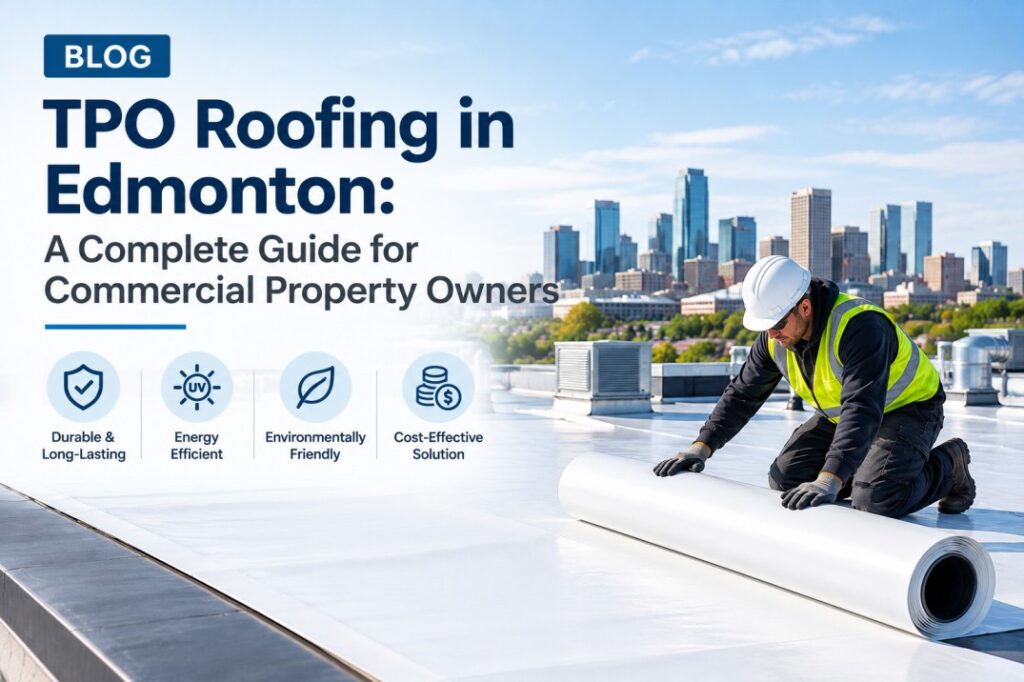
TPO — thermoplastic polyolefin — has become one of the most widely discussed commercial flat roofing systems in North America, and that conversation has reached Edmonton’s property management market in a meaningful way. First introduced to commercial roofing in the early 1990s, TPO now accounts for approximately 40 percent of the single-ply commercial roofing market across North America. Its white reflective surface, heat-welded seam system, and competitive price point have made it a genuinely popular system for commercial buildings where energy efficiency and installation speed matter.
But as with every roofing system discussion in Edmonton, the national conversation about TPO needs to be filtered through Alberta’s specific climate reality. Edmonton’s Climate Zone 7A conditions — with their -35°C winter extremes, 200-plus annual freeze-thaw cycles, summer hailstorms, and significant UV exposure during long summer days — create a performance environment that makes some TPO specifications appropriate and others genuinely problematic.
This guide covers everything Edmonton commercial property owners and facility managers need to know about TPO roofing — what it is, how it’s installed, where it performs well in Alberta’s climate, where its limitations show up, what it costs in 2026, and which specification decisions are non-negotiable for Edmonton applications.
What Is TPO Roofing?
TPO stands for thermoplastic polyolefin — a single-ply roofing membrane manufactured from a blend of polypropylene and ethylene-propylene rubber, reinforced with a polyester scrim. It is a thermoplastic material, which means it can be repeatedly softened by heat and re-hardened on cooling — a characteristic that enables the heat-welded seam system that is one of TPO’s most important technical features.
TPO membranes are manufactured in rolls, typically 1.5 to 3 metres wide, in white, grey, or tan surface colours. The white formulation is the most commonly specified for commercial applications because it provides the highest solar reflectivity — reflecting 70 to 80 percent of incoming solar radiation and earning Energy Star cool-roof designation under most evaluation programs.
Membrane thickness options include:
- 45-mil — the entry-level specification, appropriate for some residential applications and light commercial use in mild climates
- 60-mil — the standard commercial specification for Edmonton and Alberta’s Climate Zone 7A
- 80-mil — premium specification offering improved puncture resistance, enhanced seam performance, and extended warranty eligibility
The distinction between these thicknesses is not a minor specification detail for Edmonton property managers — it is one of the most consequential decisions in any TPO roofing project, and it is addressed in detail below.
How TPO Is Installed in Edmonton
TPO membrane can be installed using three primary methods, each with different performance characteristics for Edmonton’s climate:
Fully Adhered Installation
The TPO membrane is bonded directly to the insulation board using a water-based or solvent-based bonding adhesive applied to both the membrane underside and the insulation surface. After appropriate open time, the membrane is carefully rolled into the adhesive and pressed firmly to create continuous bond across the full membrane area. Seams between adjacent TPO sheets are heat-welded using a hot-air welding gun.
Fully adhered TPO installation delivers the best wind uplift resistance and the most consistent long-term performance in Edmonton’s climate. The continuous adhesive bond beneath the membrane distributes thermal movement stress evenly rather than concentrating it at mechanical fastener points. Fully adhered systems also eliminate the air movement pathway between membrane and deck that mechanically fastened systems allow — a performance advantage in Edmonton’s extreme wind and temperature environment.
Mechanically Fastened Installation
The TPO membrane is attached to the roof deck using factory-engineered fasteners and plates driven through the membrane and insulation into the structural deck, with seams heat-welded between adjacent sheets. Mechanically fastened TPO is the most common installation method globally because it is faster and less sensitive to adhesive cure conditions than fully adhered.
In Edmonton’s climate, mechanically fastened TPO carries a specific consideration: the exposed fastener heads beneath the membrane create thermal bridging points that experience repeated differential movement through 200-plus annual freeze-thaw cycles. Over time, this can cause membrane fatigue at fastener locations. Properly designed mechanically fastened TPO systems with appropriate fastener patterns and plate sizes mitigate this risk — but the design quality matters more in Edmonton’s extreme thermal cycling environment than in milder markets.
Induction-Welded Installation
A specialty installation method where factory-embedded metal discs in the insulation are activated by induction welding equipment after the membrane is placed, bonding the membrane to the insulation at the disc locations without penetrating the membrane surface. Induction welding eliminates exposed fasteners while achieving attachment comparable to mechanical fastening. This method is used less commonly in Edmonton’s market but is worth knowing as an option for projects where membrane penetration is specifically undesirable.
The Heat-Welded Seam: TPO’s Core Technical Advantage
The single most important technical feature of TPO roofing — and the primary reason it is a viable commercial flat roofing system for Edmonton’s climate — is the heat-welded seam.
When TPO sheets are joined using a hot-air welding gun at the correct temperature and overlap width, the thermoplastic material at the seam interface fuses together permanently. The welded seam is not a bond between two separate surfaces held together by adhesive — it is a single fused piece of membrane. When executed correctly, the weld creates a seam as strong as the membrane body itself.
This heat-welded seam performance is what separates TPO from EPDM in Edmonton’s freeze-thaw environment. EPDM seams depend on adhesive bonds that accumulate stress through 200-plus annual freeze-thaw cycles. TPO heat-welded seams move with the membrane through those same cycles without the progressive adhesive fatigue that creates EPDM’s dominant failure mode in Edmonton.
The critical qualifier is “when executed correctly.” TPO weld quality is highly dependent on operator skill, equipment calibration, and installation conditions. Cold Edmonton installation days, windy rooftop conditions, and temperature variability through a single installation day all affect weld quality in ways that experienced TPO installers must actively manage. An improperly welded TPO seam — one that looks solid from the surface but has inadequate fusion depth — performs worse than a properly bonded EPDM seam because it creates a false confidence in the installation’s integrity.
This is why TPO installation quality in Edmonton’s climate depends more on installer experience and equipment quality than most other roofing systems. Requesting evidence of completed TPO projects and actual weld testing results from any Edmonton TPO contractor is not excessive due diligence — it is the minimum appropriate verification.
TPO Performance in Edmonton’s Climate: Where It Excels
Reflective Energy Performance
TPO’s white reflective surface is its most marketable performance feature — and for Edmonton commercial buildings where summer cooling loads are significant, it delivers real operational value. The 70 to 80 percent solar reflectivity of white TPO reduces rooftop surface temperatures by 20 to 35 degrees Celsius compared to dark SBS modified bitumen or standard black EPDM surfaces during peak summer conditions.
For Edmonton commercial buildings with significant interior cooling requirements — cold storage facilities, food processing buildings, server rooms, data centres, pharmaceutical warehouses, and large retail spaces with substantial lighting loads — white TPO roofing reduces the solar-gain contribution to cooling loads during Edmonton’s July and August peak. This translates to measurable reductions in mechanical cooling energy cost.
For Edmonton commercial buildings that are heating-dominated rather than cooling-dominated — warehouses without significant internal heat sources, light industrial facilities, small retail units — the summer energy savings benefit is real but less financially significant than in warmer markets where cooling loads dominate year-round.
Heat-Welded Seam Reliability
As described above, properly executed TPO heat-welded seams are a genuine performance advantage for Edmonton’s freeze-thaw environment relative to adhesive-bonded systems. A quality TPO seam weld is chemically fused — there is no adhesive layer to fatigue, no tape to peel, and no progressive bond degradation from thermal cycling.
This seam reliability is why premium-specification TPO — properly welded by experienced installers on well-prepared substrates — can achieve the 20 to 30 year service life that manufacturer warranties promise. The performance gap between a well-welded and poorly welded TPO seam is more consequential in Edmonton’s climate than anywhere else in Canada because of the freeze-thaw cycle count that stresses every seam imperfection.
Cool Roof Code Compliance
Certain Edmonton commercial building types and occupancies benefit from or require cool roof compliance under specific design standards. White TPO’s solar reflectance index (SRI) — typically 80 to 110 depending on the specific product — meets cool roof requirements under ASHRAE 90.1 and other energy code standards that may be applicable to some Edmonton commercial building projects. For projects where cool roof specification is a design requirement, TPO is typically the most cost-effective membrane option that meets the standard.
TPO Limitations Specific to Edmonton’s Climate
Membrane Thickness Is Not Optional
The most critical decision in any Edmonton TPO project is membrane thickness — and it is the decision most commonly underspecified by contractors who prioritize competitive bid price over long-term performance.
45-mil TPO is under-specified for Edmonton commercial applications. At this thickness, TPO membranes are vulnerable to cold-temperature brittleness below -20°C — a temperature Edmonton regularly experiences during winter nights. 45-mil TPO seams also have less material volume at the weld zone, producing weaker fusion bonds that are more susceptible to freeze-thaw stress than thicker membranes. Edmonton’s pre-2010 TPO performance problems — the reason some Edmonton property managers remain skeptical of TPO — were largely driven by under-specification of entry-level 45-mil membranes that were not adequate for Alberta’s climate extremes.
60-mil TPO is the minimum appropriate specification for Edmonton commercial flat roofing. At 60-mil, the membrane body provides meaningful cold-temperature flexibility, the weld zone has adequate material volume for strong heat-fusion bonds, and the puncture resistance is sufficient for Edmonton’s foot traffic and hail exposure conditions.
80-mil TPO is the preferred specification for Edmonton industrial applications, large-footprint buildings, buildings with high foot traffic on the roof surface, and buildings in high-hail-exposure locations within Alberta’s identified hail corridor. The cost difference between 60-mil and 80-mil TPO runs approximately $0.75 to $1.50 per square foot in material cost — a meaningful premium that delivers measurably better long-term performance in Edmonton’s most demanding climate conditions.
Any Edmonton TPO proposal that specifies 45-mil membrane should be returned with a question about why, and the answer should be satisfactory before the project proceeds.
Weld Quality Is Weather-Dependent During Installation
TPO hot-air welding requires equipment calibrated for ambient temperature — the heat output needed to achieve proper fusion at +20°C is different from what’s required at +5°C, and both are different from what’s needed on a cold windy October Edmonton rooftop at +2°C.
Experienced Edmonton TPO installers adjust equipment settings throughout the day as temperature changes and monitor weld quality continuously. Less experienced crews apply standard settings regardless of conditions — producing inconsistent weld quality that may look acceptable visually but contains incompletely fused zones that fail under thermal cycling.
For Edmonton TPO projects scheduled in April or October, when temperatures are marginal for quality welding, the specification should include weld testing requirements — either destructive peel tests on sample welds or non-destructive testing — to verify fusion quality before the membrane is accepted.
Long-Term Formulation Durability Questions
TPO as a product category has undergone significant formulation evolution since its introduction in the early 1990s. Early TPO formulations — particularly those installed before approximately 2005 — showed premature degradation in Alberta’s UV exposure and thermal cycling environment. The plasticizer migration that caused early TPO products to become brittle and crack gave the system a difficult reputation in Alberta that persists in some segments of the Edmonton property management community.
Current-generation TPO from major manufacturers — Carlisle, Firestone, GAF, Johns Manville, Versico — is significantly improved from early formulations. Premium 60-mil and 80-mil products from established manufacturers with documented Alberta-climate track records have largely resolved the durability issues that characterized earlier generations. However, the Edmonton market’s historical experience with early TPO reinforces the importance of manufacturer selection — not all TPO is the same product, and a low-price TPO from an unfamiliar manufacturer carries more formulation risk than established products with documented Alberta performance history.
TPO Roofing Cost in Edmonton — 2026 Ranges
TPO roofing installation costs in Edmonton for 2026 — including fully adhered 60-mil membrane installation, insulation to current Alberta Building Code minimum (RSI 3.52 / R-20), standard drain and flashing details, and project management — run approximately:
| Project Scope | 2026 Edmonton Cost Range |
|---|---|
| TPO re-roofing overlay (60-mil, over sound substrate) | $9 – $13 per square foot |
| Full TPO replacement (tear-off, insulation, 60-mil membrane) | $12 – $17 per square foot |
| Full TPO replacement (tear-off, insulation, 80-mil membrane) | $14 – $20 per square foot |
| TPO patch repair (per repair event, minor) | $500 – $1,200 |
| TPO seam re-weld repair (per linear metre) | $80 – $150 per linear metre |
These 2026 ranges compare to SBS modified bitumen at $9 to $16 per square foot and EPDM at $8 to $14 per square foot for full replacement projects — placing TPO at competitive pricing for 60-mil specification and at a slight premium for 80-mil against standard SBS.
The seam re-weld repair rate reflects one of TPO’s maintenance advantages over adhesive-bonded systems: a TPO seam that has partially separated or failed can be re-welded with a hand-held heat gun and fresh TPO cover strip material, restoring full weld integrity without membrane replacement. EPDM seam repairs using adhesive patches carry more long-term vulnerability than a properly executed TPO re-weld.
For complete Edmonton commercial flat roofing cost context across all systems, see our commercial flat roof repair and replacement cost guide.
TPO Maintenance Requirements in Edmonton
TPO flat roofs on Edmonton commercial buildings require maintenance attention focused on the specific failure modes that Edmonton’s climate creates:
Biannual professional inspections remain the correct maintenance cadence — fall before freeze-up and spring after snowmelt. A professional commercial roof inspection for a TPO building should include close visual and physical inspection of all seam edges and weld laps, particularly at penetration flashings and parapet wall termination details where thermal movement concentrates seam stress. TPO seam inspection is more straightforward than EPDM adhesive bond testing — partially failed weld seams typically show visible edge separation that probe testing confirms.
Seam edge inspection at all penetration details. TPO penetration flashings at equipment curbs, pipe penetrations, and drain collars are the most maintenance-critical details. Unlike EPDM where adhesive bond failure is the concern, TPO penetration flashing failures typically occur at the overlap edges where the field membrane meets the prefabricated flashing piece — spots where weld quality during installation may have been compromised by geometry or temperature. Annual physical probe testing at all penetration overlap edges is appropriate maintenance practice for Edmonton TPO buildings.
Termination bar sealant maintenance. TPO membrane terminates at parapet walls and roof edges under metal termination bars with sealant applied over the bar edge. This sealant weathers in Edmonton’s climate over 5 to 8 years, hardening and developing hairline cracks. Fall maintenance should include sealant assessment and replacement at all termination bar edges — the same maintenance requirement as SBS and EPDM systems.
Walk pad installation and maintenance. TPO membrane surfaces, particularly white TPO, show foot traffic wear patterns over time. Walk pads on all primary access routes to rooftop mechanical equipment should be installed at original project time and inspected during every maintenance visit. For a comprehensive commercial roof repair and maintenance program for your Edmonton TPO building, contact our team.
Post-hail assessment. After any significant Edmonton hailstorm, TPO membrane should be professionally assessed for impact damage. Large hail on 60-mil TPO can cause puncture or membrane bruising that isn’t immediately visible but compromises the membrane body — creating a future failure point if not identified and addressed before Edmonton’s fall freeze-thaw season. Our detailed guide on hail damage assessment for Edmonton commercial flat roofs covers this process.
When TPO Makes Sense for Your Edmonton Commercial Building
TPO rubber roofing is the right system to specify for Edmonton commercial buildings in specific scenarios:
When summer cooling loads are a significant operational cost. Cold storage, food processing, large retail, server rooms, and data centres in Edmonton see meaningful energy savings from white TPO’s reflective surface relative to dark membrane alternatives. For heating-dominated occupancies without significant cooling loads, the energy argument for TPO over SBS is weaker.
When project timing falls within the May through September optimal installation window. Quality TPO weld installation in Edmonton benefits from the full summer installation window where temperature stability supports consistent weld quality. October TPO projects require additional quality oversight that adds project management cost and risk.
When 60-mil or 80-mil membrane is specified and the contractor has documented Edmonton TPO experience. These two conditions together are non-negotiable for Edmonton TPO projects. Under-specified membrane and inexperienced weld operators are the two factors that produce the poor Edmonton TPO outcomes that give the system a mixed local reputation.
When re-roofing over a sound existing substrate. TPO overlays over sound existing SBS or BUR systems are straightforward and cost-effective when moisture testing confirms dry insulation and the substrate is compatible. The overlay scenario eliminates tear-off cost while delivering the energy performance and seam reliability advantages of the new TPO system.
TPO is a less appropriate choice when: the building’s primary need is redundant waterproofing rather than energy efficiency (SBS two-ply redundancy is better suited); when project timing falls outside the optimal installation window without strong quality oversight provisions; or when the available Edmonton contractor pool for TPO doesn’t include documented local installation history with verifiable weld quality records.
Getting a TPO Assessment for Your Edmonton Property
Silverback Torch On Systems Ltd. installs and assesses TPO as part of our commercial flat roofing service for Edmonton properties — specifying it where its performance profile fits the building, recommending SBS or EPDM where they’re better suited, and never recommending any system based on margin rather than performance.
We specialize in commercial flat roofing in Edmonton across all major membrane systems. If your Edmonton commercial building’s flat roof needs replacement or your existing TPO system needs assessment or repair, contact our Edmonton team for a free on-site evaluation and honest system recommendation.
Quick Reference: TPO Roofing in Edmonton
| Factor | TPO Performance in Edmonton |
|---|---|
| Cold temperature flexibility | Good (60-mil+) / Risk (45-mil below -20°C) |
| Heat-welded seam performance | Excellent when properly executed |
| UV and energy performance | Excellent — 70–80% solar reflectivity |
| Hail resistance | Good (60-mil) / Better (80-mil) |
| Freeze-thaw seam performance | Better than adhesive EPDM seams |
| Installation temperature window | May–September optimal for quality welds |
| Weld quality consistency | Highly operator and equipment dependent |
| Early formulation history in Alberta | Pre-2010 issues resolved in current-gen products |
| 2026 Edmonton cost range (60-mil) | $9 – $17 per sq ft (overlay to full replacement) |
| 2026 Edmonton cost range (80-mil) | $14 – $20 per sq ft (full replacement) |
| Minimum Edmonton specification | 60-mil — 45-mil is under-specified |
| Best Edmonton application | Cooling-load buildings, reflective performance needed |
| Maintenance priority | Seam edge inspection, sealant, walk pads, post-hail |
Related reading for Edmonton commercial property owners:
- SBS vs TPO vs EPDM: Which Flat Roof System Is Right for Your Edmonton Commercial Building?
- EPDM Rubber Roofing in Edmonton: A Complete Guide for Commercial Property Owners
- Commercial Flat Roof Repair and Replacement Cost in Edmonton: A 2026 Guide
- Hail Damage on Commercial Flat Roofs in Edmonton: How to Assess, Document, and Respond