


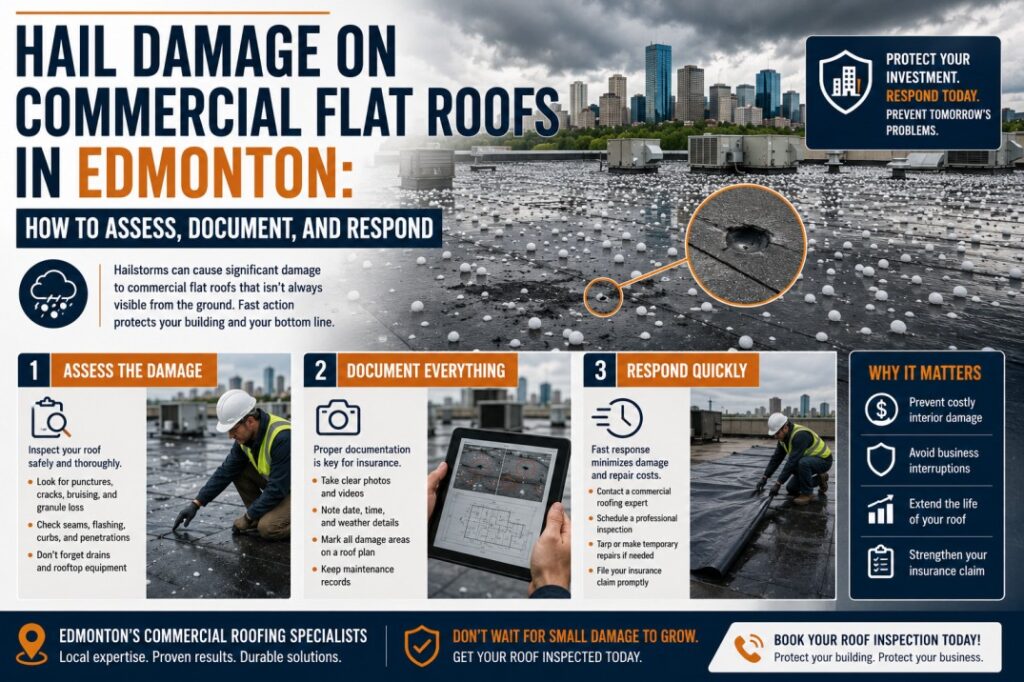
Alberta’s 2025 hail season produced over $2.8 billion in insured losses across the province. The coverage that followed focused almost entirely on residential shingles — the visible bruising, the granule loss, the Class 4 upgrade conversations. What got very little attention was what the same storms did to Edmonton’s commercial flat roofs.
Commercial flat roofing systems respond to hail impact differently than residential shingles. The damage patterns are different, the assessment process is different, the repair approach is different, and critically — the consequences of missing the damage are different. A residential homeowner with undetected hail damage faces a future leak. A commercial property manager with undetected hail damage on a flat SBS or TPO membrane faces moisture infiltration into insulation, accelerated seam failure through subsequent freeze-thaw cycling, potential warranty voidance, and a repair scope that multiplies with every Edmonton winter that passes before it’s addressed.
This guide is written specifically for Edmonton commercial property owners and managers — not residential homeowners — to understand how hail affects commercial flat roofing systems, what proper post-storm assessment looks like, and what decisions need to be made quickly.
Why Hail Affects Commercial Flat Roofs Differently
Residential hail damage guides focus on granule loss from asphalt shingles and soft metal denting on vents and flashings — both visible indicators that translate directly to insurance documentation. Commercial flat roofing systems don’t always present damage the same way.
SBS modified bitumen membranes — the most common commercial flat roofing system in Edmonton — are significantly more hail-resistant than asphalt shingles by design. The two-ply construction gives SBS systems a meaningful advantage: the granulated cap sheet absorbs and distributes hail impact, and even if the cap sheet is bruised or punctured by large hail, the base sheet beneath provides a secondary waterproof barrier. This is one of SBS’s most important Edmonton-specific advantages during Alberta’s hail season.
However, SBS hail damage that doesn’t immediately breach the membrane can still cause long-term problems. Large hail impacts that fracture the cap sheet surface without full penetration create micro-fractures in the membrane. These fractures may not leak initially — but they become entry points for water as UV radiation, thermal movement, and subsequent freeze-thaw cycling work on the compromised areas over the following one to three years.
TPO single-ply membranes have less redundancy than two-ply SBS — a hail impact that penetrates the membrane goes directly into the insulation. Additionally, hail impacts near TPO seam areas can compromise weld integrity at the membrane edges in ways that aren’t immediately visible from the surface.
EPDM membranes can withstand hail impact relatively well given their rubber composition — the material deforms and recovers rather than fracturing — but large hail can still cause punctures, and the adhesive seam details around drains and penetrations are vulnerable to impact-related displacement.
What to Check After a Hailstorm — The Commercial Flat Roof Assessment
Unlike a steep residential roof where hail damage is often visible from the ground, commercial flat roofs require a proper on-roof assessment. Do not rely on a ground-level check for any commercial flat roofing system.
Step 1 — Assess timing and storm severity first
Before stepping on the roof, document the storm. Environment Canada severe weather alerts for the Edmonton area on the storm date establish the official record of storm occurrence, hail size, and severity. This documentation is essential for any insurance involvement. Note that golf-ball-sized hail (44mm) and larger causes more direct penetration risk to flat membrane systems, while smaller hail (under 25mm) is more likely to cause surface fracturing that becomes problematic over time rather than immediately.
Step 2 — Inspect the membrane surface systematically
Walk the entire roof surface — not just visible areas from access points — and assess the membrane in sections. On SBS cap sheets, look for:
- Impact marks — circular or oval depressions in the granule surface where hail struck. Large impacts may have displaced granules, exposing the darker bitumen beneath. These are similar to granule loss on residential shingles and indicate cap sheet surface fracturing.
- Cap sheet punctures — direct breaches through the cap sheet that are visible as openings or tears. These require immediate repair regardless of whether the base sheet beneath is intact.
- Membrane splitting or cracking — linear or radiating fractures extending from impact points, particularly common on older or UV-degraded membranes where the material has lost some flexibility.
On TPO membranes, look for:
- Surface scuffing or whitening at impact points
- Any visible punctures through the membrane
- Seam area disturbance near impact zones
Step 3 — Inspect all soft metal details
Every metal component on the commercial flat roof is a hail damage indicator — and a potential damage point in its own right. Check:
- Drain bowls and clamping rings for impact dents that may have shifted the drain assembly
- Metal flashings at parapet walls, equipment curbs, and penetration collars for denting that has separated sealant joints or lifted flashing edges
- Rooftop HVAC unit casings for impact dents (these don’t affect the roofing system but document storm severity for insurance purposes)
- Vent caps and pipe collars for denting or displacement
- Scupper boxes for deformation that may affect drainage direction
These metal components dent at lower hail energies than flat membranes sustain damage — which means significant metal denting almost always indicates meaningful membrane stress, even if surface damage isn’t immediately obvious.
Step 4 — Assess drainage function post-storm
Heavy hailstorms deposit significant debris on commercial flat roofs — including hailstones themselves, which can accumulate in drainage sumps and block internal drains while melting. After any significant hailstorm, check that all drains are clearing normally and that no debris accumulation is creating ponding zones. On Edmonton commercial roofs, hail debris left in drainage channels can contribute to drain freezing if temperatures drop before it clears.
Step 5 — Inspect penetrations and equipment curbs closely
The interface between the flat membrane and any penetration — HVAC curbs, pipe boots, exhaust fans, skylights — is the most vulnerable area for hail-induced damage. These transition details require closer inspection than open membrane areas because impact displacement at these points is less obvious visually but more consequential for waterproofing.
Hidden Hail Damage: What a Visual Inspection Misses
The most important thing Edmonton commercial property managers need to understand about post-hail assessment on flat roofs is this: a visual inspection alone is not sufficient to determine whether meaningful damage has occurred.
Insulation moisture from membrane micro-fractures develops over weeks and months after a hailstorm, not immediately. A membrane that appears intact after impact may have micro-fractures that admit water during the first significant rainstorm following the storm. By the time that moisture reaches insulation and reduces thermal performance or begins affecting the deck, it’s been there long enough to require more than patch repairs.
Infrared moisture scanning after a hailstorm — conducted by a professional commercial roof inspection team — identifies wet insulation beneath the membrane that developed from storm-related damage. This is standard practice for post-storm commercial roof assessment in Edmonton and should be part of any thorough evaluation of hail impact on a commercial flat roof.
The 48-to-72 hour window immediately after a storm is the ideal time to begin assessment documentation — storm patterns are recent, any water intrusion from direct punctures is fresh, and insurance documentation is strengthened by prompt professional evaluation.
Repair vs. Continued Monitoring: Making the Right Call
After a complete post-storm assessment, commercial property managers typically face one of three scenarios:
Scenario 1 — No visible damage, dry insulation testing The storm passed without causing detectable damage to the roofing system. Document the assessment with photographs and written findings. Schedule a follow-up commercial roof repair and maintenance visit in 60 to 90 days to assess any delayed membrane changes from impact stress that weren’t visible immediately.
Scenario 2 — Surface damage without penetration, dry insulation Cap sheet impact marks, minor surface fracturing, or displaced granules without full membrane penetration and dry insulation beneath. These conditions require targeted membrane repair to address the surface fractures before they become penetration points. This is the most common outcome from moderate Edmonton hailstorms on SBS systems — the two-ply construction absorbed the impact, but the cap sheet needs attention. Repair promptly before freeze-thaw cycling works on the compromised surface through winter.
Scenario 3 — Penetrations present or wet insulation detected Any direct membrane penetration or insulation moisture detected through infrared scanning requires immediate repair to prevent escalation. Depending on the extent of damage, this may range from targeted patch repairs on isolated areas to partial or full section replacement where insulation saturation has occurred. Learn more about what this decision process involves in our guide to commercial re-roofing vs. full replacement in Edmonton.
Documentation for Insurance and Warranty Purposes
Commercial property insurance policies in Alberta typically cover sudden and accidental hail damage to roofing systems. However, the documentation requirements for commercial claims are more demanding than residential claims — particularly for flat roofing systems where damage isn’t always visible in standard photographs.
A professional post-storm commercial roof assessment should produce:
- Written inspection report with date, storm documentation reference, and systematic findings by roof section
- Photographs of every impact mark, surface fracture, metal dent, and flashing disturbance identified
- Infrared scan results documenting insulation moisture distribution if conducted
- Written repair recommendation with scope and material specifications
This documentation serves both the insurance claim process and your manufacturer warranty position. Most commercial roofing membrane warranties require that storm damage be reported and repaired promptly — delayed repairs that allow water infiltration to develop from storm damage can complicate warranty claims significantly.
Act Before Edmonton Winter Arrives
The timing pressure on post-hail assessment and repair for Edmonton commercial flat roofs is real. A hailstorm that hits in July or August leaves a narrow window before freeze-thaw cycling begins in October. Every micro-fracture in an SBS cap sheet that goes unaddressed through October becomes a freeze-thaw stress point that expands and deepens through the winter months.
The repair cost difference between addressing hail-induced cap sheet fracturing in September versus addressing the insulation damage and membrane deterioration that develops through a winter of freeze-thaw cycling on compromised areas is significant — often by a factor of three to five.
Silverback Torch On Systems Ltd. specializes in commercial flat roofing in Edmonton, including post-storm assessment, hail damage repair, and professional commercial roof inspection with photographic documentation for insurance and warranty purposes.
If your Edmonton commercial building took a hailstorm this season, contact our team to schedule a professional post-storm assessment before freeze-up — the window to address this cost-effectively is always shorter than it feels.
Related reading for Edmonton commercial property owners: