


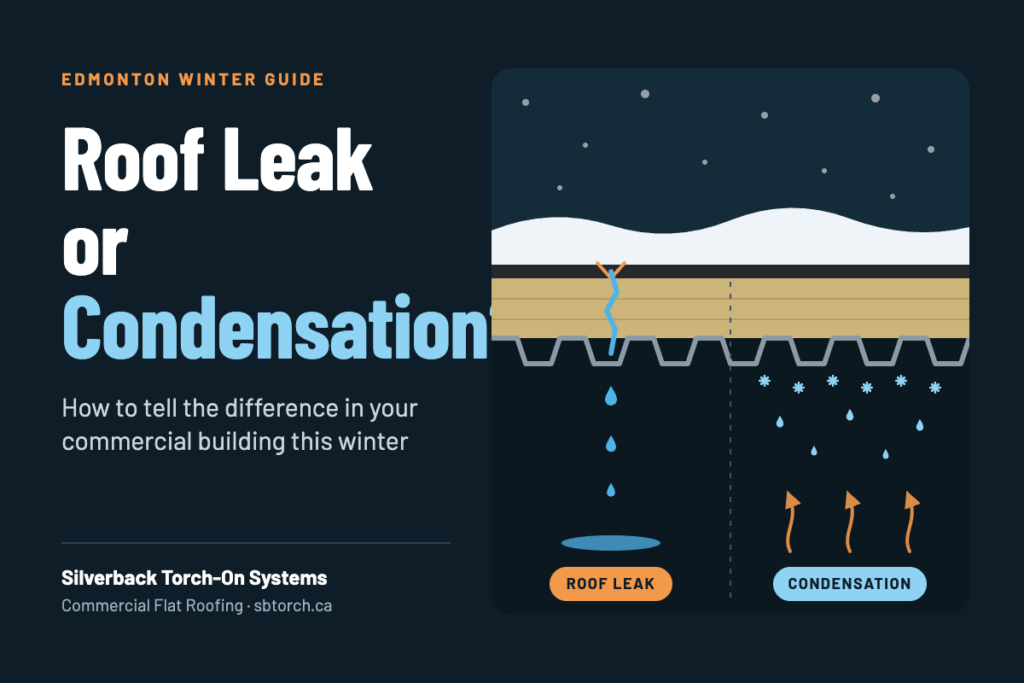
It’s a cold January morning. A tenant calls: water is dripping from the ceiling. There’s been no rain and no snowmelt, and the sky is clear. So is the roof leaking?
Maybe not. Every Edmonton winter, a large share of “roof leak” calls in commercial buildings turn out to be condensation. That’s water that comes from inside the building, not through the roof.
Telling the difference matters. Fix the roof when the problem is condensation, and you waste money while the water keeps coming. Assume it’s condensation when the roof really is leaking, and you let damage spread through the insulation all winter.
This guide shows you how to tell them apart, what causes each, and how to fix the real problem.
Quick Answer: Is It a Roof Leak or Condensation?
It’s more likely condensation if:
- Water appears during extreme cold or right after a cold snap ends, without any snow, rain or melting
- Drips appear in many spots across a large area, not one spot
- You see frost or water droplets on the underside of the steel deck, fasteners or ductwork
- The building has high indoor humidity, such as a restaurant, gym, pool, car wash or food plant
It’s more likely a roof leak if:
- Water appears during snowmelt, a thaw, freezing rain or rain
- Drips keep returning to the same spot
- The leak is near drains, rooftop units, parapet walls or other penetrations
- You see stained ceiling tiles that grow after each weather event
Roof Leak vs Condensation: Side-by-Side
| Sign | Condensation | Roof Leak |
|---|---|---|
| When it appears | Extreme cold, or as a cold snap ends | During thaw, snowmelt, rain or freezing rain |
| Weather needed? | No precipitation required | Usually tied to water on the roof |
| Where it appears | Widespread, many small drips | Same spot, again and again |
| What you see | Frost or droplets on the deck, fasteners or ducts | Localized stains that grow over time |
| Common locations | Near exterior walls, ceiling penetrations, high-humidity areas | Near drains, RTUs, flashings, parapets, seams |
| Rust | Rusty screw tips across the deck underside | Rust and staining in one concentrated area |
| Who fixes it | Humidity control, air sealing, HVAC, sometimes roof assembly upgrades | Roof repair by a commercial roofing contractor |
How Condensation Forms in Commercial Buildings
Warm indoor air holds moisture. In winter, that air rises toward the roof and escapes through gaps around light fixtures, ductwork, ceiling hatches and any break in the vapour retarder.
When it reaches the cold underside of the roof deck or the insulation, it cools down to its dew point. The moisture turns into water, or frost when it’s very cold.
In Edmonton, this often builds up as frost inside the roof assembly during a long cold snap. The moment temperatures rise, or the building heats up on a sunny day, that frost melts all at once. Suddenly it’s “raining” inside your building on a clear day, and it looks exactly like a leak.
Buildings most at risk:
- Restaurants and commercial kitchens
- Gyms, pools and recreation centres
- Car washes
- Food processing, breweries and manufacturing plants
- Newly built buildings, where concrete and drywall are still releasing moisture
- Older buildings with little or no vapour retarder in the roof
Other Winter Water Sources That Aren’t the Roof
Before blaming the roof, check these common culprits too:
- Frozen rooftop unit condensate lines. When an RTU’s condensate drain freezes, water can back up into the unit and leak into the building.
- Sweating ductwork and pipes. Uninsulated ducts and cold water lines can drip in humid spaces.
- Exhaust fans and vents. Poorly sealed or uninsulated exhaust ducts let warm, moist air condense inside them.
- Wall and window leaks. Water can travel along the structure and show up far from where it entered.
Why Flat Roofs Do Leak More in Winter
That said, real roof leaks are common in Edmonton winters too. Here’s why flat roofs leak when snow is present, even if they handle rain fine:
- Frozen drains. Ice blocks internal drains and scuppers, so meltwater ponds with nowhere to go.
- Ponding meltwater. Standing water sits against seams and flashings far longer than rain would.
- Freeze-thaw damage. Water enters tiny cracks, freezes, expands and widens them a little more each cycle.
- Ice pressure at flashings. Ice forming at parapet walls and curbs can push flashings out of place.
- Unrepaired summer damage. Hail bruises and storm damage often stay hidden until winter meltwater finds them.
Learn more in our guide to snow load and ice dams on Edmonton commercial flat roofs.
How to Find the Real Source: A 6-Step Check
1. Write down the timing. Note the date, time and weather when water appears. Was it during a thaw, during extreme cold, or right after a cold snap ended? This one record often answers the question.
2. Look above the ceiling. If it’s safe to do so, lift a ceiling tile and look at the underside of the roof deck. Frost or droplets spread across the deck point to condensation. A wet trail coming from one spot points to a leak.
3. Check indoor humidity. A simple hygrometer helps here. High winter humidity inside a commercial space is a strong sign of a condensation problem.
4. Check your HVAC. Have your mechanical contractor look at RTU condensate lines, humidifiers, exhaust fans and duct insulation.
5. Have the roof surface checked. A roofing professional can look for ice-blocked drains, ponding, damaged flashings and seams directly above the problem area. Don’t walk an icy roof yourself.
6. Get a moisture survey. Infrared scanning or moisture mapping shows where water is sitting inside the roof assembly. It’s the most reliable way to know whether the insulation is wet and where water is getting in. Our commercial roof inspection service includes written reports with photo documentation.
Important: Condensation Can Still Destroy Your Roof
Even when condensation is the cause, it can still damage your roof. Moisture that condenses inside the roof assembly winter after winter:
- Soaks the insulation, which then loses much of its insulating value
- Rusts the steel deck and fasteners
- Weakens the adhesion of the roofing layers
- Can lead to mould and failed roof components
If condensation has been happening for years, the roof assembly itself may need repair or replacement. The fix is usually rebuilding the roof with a proper vapour retarder and enough insulation to keep the dew point out of the assembly. This is one reason vapour control is a critical step in any new flat roof installation in Edmonton.
How to Fix Each Problem
If it’s condensation:
- Lower indoor humidity with better ventilation or dehumidification
- Seal air leaks around ceiling penetrations, light fixtures and hatches
- Insulate ducts, pipes and exhaust lines
- Fix frozen or faulty RTU condensate drains
- At re-roofing time, add a proper vapour retarder and upgrade insulation. See our guide to commercial roof insulation in Edmonton
If it’s a roof leak:
- Clear ice and snow from drains so meltwater can escape
- Make a temporary emergency repair to stop water before the next thaw. See our guide to emergency winter flat roof repair
- Schedule a permanent repair at the source, such as a seam, flashing or penetration. Learn how torch-on roof repair delivers permanent leak solutions
- If leaks appear in many places and the insulation is wet, plan for commercial re-roofing
4 Costly Winter Mistakes to Avoid
- Patching the roof for a condensation problem. The water keeps coming, and you’ve paid for a repair you didn’t need.
- Calling every winter drip “just condensation.” A real leak left alone all winter soaks the insulation and multiplies the repair cost.
- Walking or shovelling the roof yourself. Icy roofs are dangerous, and metal shovels cut membranes.
- Waiting until spring. By April, a small winter leak can mean wet insulation across a large area.
Frequently Asked Questions
Why is my commercial roof leaking when it hasn’t rained or snowed?
If water appears without any precipitation or melting, condensation is the most likely cause. Frost builds up inside the roof assembly during cold weather and melts when temperatures rise or the building warms up.
Why does my flat roof only leak in winter?
Flat roofs often leak in winter because ice blocks the drains, meltwater ponds against seams and flashings, and freeze-thaw cycles widen small cracks. Condensation inside the roof assembly can also look like a winter-only leak.
Can a flat roof be repaired in winter in Edmonton?
Yes. Temporary emergency repairs can be made in winter to stop water entering the building. Permanent repairs and larger projects are usually completed once weather allows.
How do roofers find a leak on a flat roof?
Professionals combine a visual inspection with infrared scanning or moisture mapping. These show where water is moving inside the roof assembly, which is often far from where it drips inside.
Does condensation mean I need a new roof?
Not always. Many condensation problems can be fixed with humidity control and air sealing. But if condensation has soaked the insulation over several winters, the roof assembly may need to be repaired or rebuilt with proper vapour control.
Who should I call first: a roofer or an HVAC contractor?
If water appears during a thaw or in the same spot each time, call a roofer first. If it appears in cold weather across a wide area, or near ducts and units, involve your HVAC contractor too. A roofing inspection can rule the roof in or out quickly.
Get a Clear Answer Before the Damage Spreads
Not sure whether it’s a roof leak or condensation? Silverback Torch-On Systems helps Edmonton property owners and managers find the real source of winter water problems. We provide inspections, moisture surveys and photo-documented reports, then permanent repairs when the roof is the cause. Our crews are COR-certified for workplace safety and specialize in commercial flat roofing in Edmonton.
Book a winter roof leak assessment or call our Edmonton team at 587-785-6924.
For year-round protection, explore our commercial roof repair and maintenance services.