

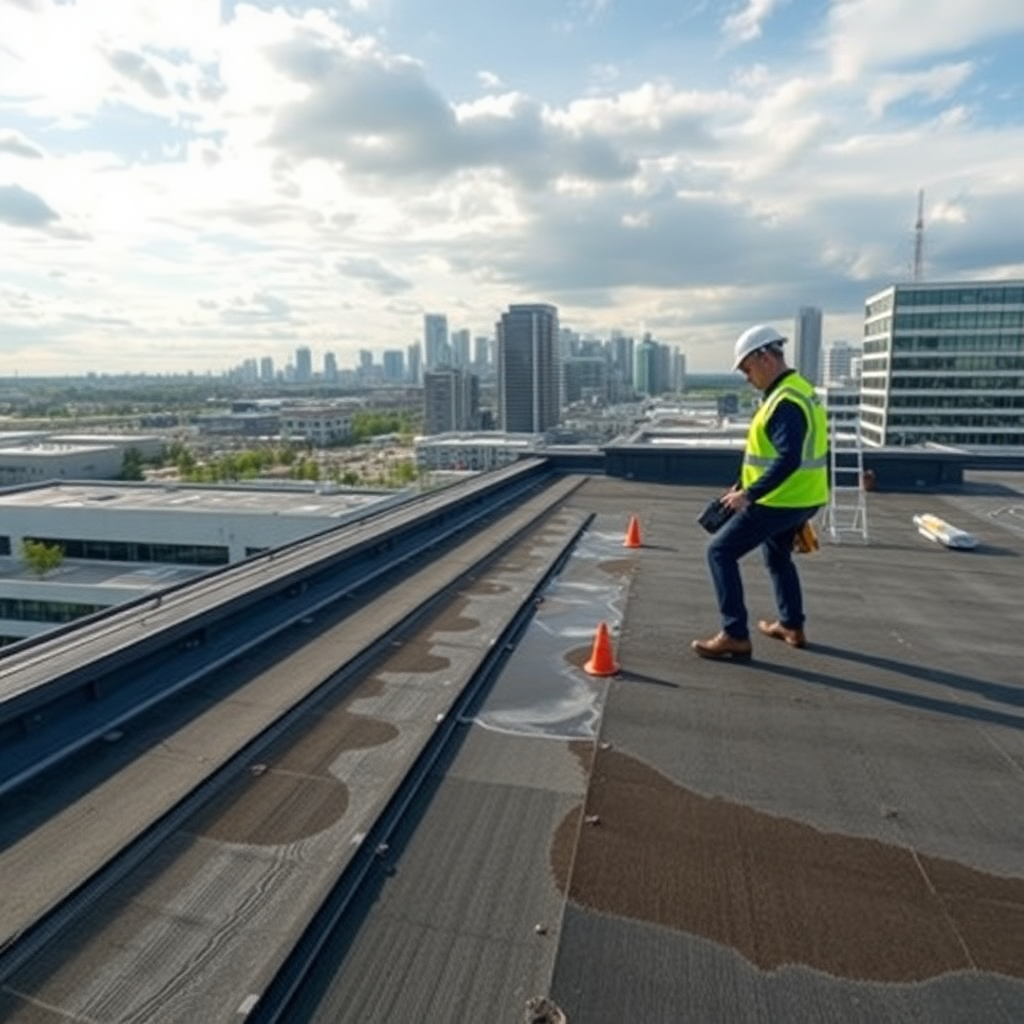
Every Edmonton building owner has been there. The maintenance call comes in — there’s a drip. Someone throws a patch on it. The next storm arrives, and the drip is back, but now it’s two drips, and one of them is near the electrical panel.
Temporary fixes on flat commercial roofs are one of the most expensive habits in property management. At Silverback Torch On Systems Ltd., we’ve been called in to correct botched patch jobs more times than we can count — jobs where a proper torch on roof repair the first time would have cost a fraction of what the eventual remediation bill came to. This guide explains why permanent leak repair matters, how torch-on technology delivers it, and when a repair is no longer enough.
Why Flat Roof Leaks in Edmonton Are Rarely Where You Think
The first thing most people get wrong about a commercial roof leak is the location. Where water appears inside your building — the ceiling stain, the drip, the puddle — is almost never where the membrane has failed above. Water enters at one point and travels laterally through the insulation assembly before it finds a way through.
This is why spray-and-pray sealant approaches fail repeatedly. If you seal the wrong spot, you’ve done nothing but delay the next call. Accurate roof leak repair in Edmonton starts with proper diagnostics: moisture mapping or infrared scanning that reveals where water is actually moving through the roof assembly, not just where it emerges indoors.
Once the true entry point is identified, the repair method matters enormously — and that’s where torch-on technology earns its reputation.
What Makes Torch On Roof Repair the Right Fix for Edmonton’s Climate
SBS modified bitumen — the membrane system used on the vast majority of flat commercial roofs in Edmonton — is engineered specifically for cold-climate performance. The rubberized polymer allows it to remain flexible well below freezing, which is exactly what you need when temperatures drop to -30°C and colder.
When this membrane fails, it needs to be repaired in kind. Torch on roof repair uses a propane heat source to fuse new SBS membrane directly to the existing system. The result is a molecular bond — not a surface adhesion, not an overlay held by cold adhesive — but an integrated repair that becomes part of the original membrane system.
Cold-applied patches, by contrast, rely on adhesive contact that degrades with UV exposure and temperature cycling. Edmonton’s climate puts those patches through hundreds of freeze-thaw cycles per season. The bond weakens, edges lift, and moisture finds its way in all over again.
Torch-on repair done correctly by a trained technician is not a patch. It is a restoration of the membrane to its original waterproof integrity.
The Real Cost of an Emergency vs. a Planned Repair
One of the clearest arguments for responding to early warning signs — rather than waiting for an active leak — is what happens to your repair bill when urgency enters the picture.
A planned torch on roof repair to address a failing seam or lifted flashing, caught during a routine inspection, might cost $800–$1,500 depending on scope. That same seam, left alone through another winter, can allow water to saturate a section of insulation board. Now the repair requires membrane removal, insulation replacement, and re-installation — a job that can run $4,000–$8,000 or more. If the water reaches the structural deck, you are looking at potential commercial roof replacement for that section, with costs that are a multiple of what early intervention would have required.
Emergency response also carries premium costs. After-hours mobilization, expedited material sourcing, and the sheer complexity of stopping an active leak in winter conditions all add to the invoice. None of that is avoidable once a leak is running — but all of it is avoidable with proactive management.
Industrial Roofing: When the Repair Environment Is the Challenge
Leak repair on a standard retail or office building is straightforward by comparison to industrial roofing services in Edmonton. Industrial facilities present layers of complexity that require specialized expertise.
Heavy rooftop equipment — HVAC arrays, exhaust stacks, industrial ventilation systems — creates concentrated load points and penetration zones where membrane failure is most likely. Chemical exhaust from manufacturing processes can degrade standard roofing materials faster than UV alone. Vibration from machinery loosens flashings and accelerates seam separation.
Silverback crews are experienced in working on active industrial sites: coordinating around operational equipment, adhering to site-specific safety requirements, and delivering repairs that account for the mechanical demands your facility places on the roof system. We don’t stop production to fix a roof; we work around it.
How to Know When Repair Is No Longer the Answer
There is a point at which continued repair investment stops making economic sense, and honest assessment requires acknowledging it. The indicators that commercial roof replacement in Edmonton has become the better path forward include:
Widespread membrane brittleness. If SBS membrane has lost its flexibility across large areas — cracking when bent, granulating heavily — localized repairs are buying months, not years.
Saturated insulation across multiple zones. Moisture mapping that reveals water trapped in the insulation assembly across more than 25–30% of the roof area typically means the economics of repair no longer work. Wet insulation dramatically reduces thermal performance and will continue spreading if not fully addressed.
Repair history with diminishing returns. If the same areas of a roof have been repaired three or more times in five years, the underlying system has likely degraded past the point where surface repairs hold.
Deck deterioration. Once structural decking shows signs of rot or corrosion from prolonged moisture exposure, the foundation for any membrane system has been compromised. This requires a full tear-off and re-deck before new roofing can be installed.
Silverback provides honest, no-pressure assessments. If your roof has years of service life left with targeted repairs, we will tell you that. If it has reached the end of its useful life, we will tell you that too — with the documentation and cost analysis to back it up.
Why Torch-On Specialists Get Better Results Than General Contractors
There is a meaningful difference between a generalist commercial roofing contractor who offers torch-on as one of several methods and a team whose entire practice is built around SBS modified bitumen systems.
Torch-on application is a skilled trade. The heat application must be precise — insufficient heat leaves the bond incomplete; too much damages the membrane or creates a fire hazard. Reading the existing membrane condition, selecting the correct product for the repair, managing propane equipment safely, and integrating the new material cleanly with the old system are all skills that improve with repetition.
Silverback technicians work exclusively with torch-on systems. That specialization means they identify failure modes that generalist crews miss, execute repairs with better technique, and produce results that hold through Edmonton winters rather than failing at the next cold snap.
All of our torch-on work is performed by trained technicians operating under our COR-certified safety program — meeting Alberta OHS requirements for open-flame roofing work on commercial and industrial sites.
Book a Leak Assessment Before the Next Storm
If your flat roof has a history of leaks, an active drip, or a repair that keeps coming back, the issue isn’t going away on its own. Edmonton’s next freeze-thaw cycle will find every weakness your current membrane has.
Contact Silverback Torch On Systems Ltd. for a complimentary diagnostic inspection and fixed-price repair estimate. We serve commercial and industrial properties across Edmonton and the surrounding Alberta region.