


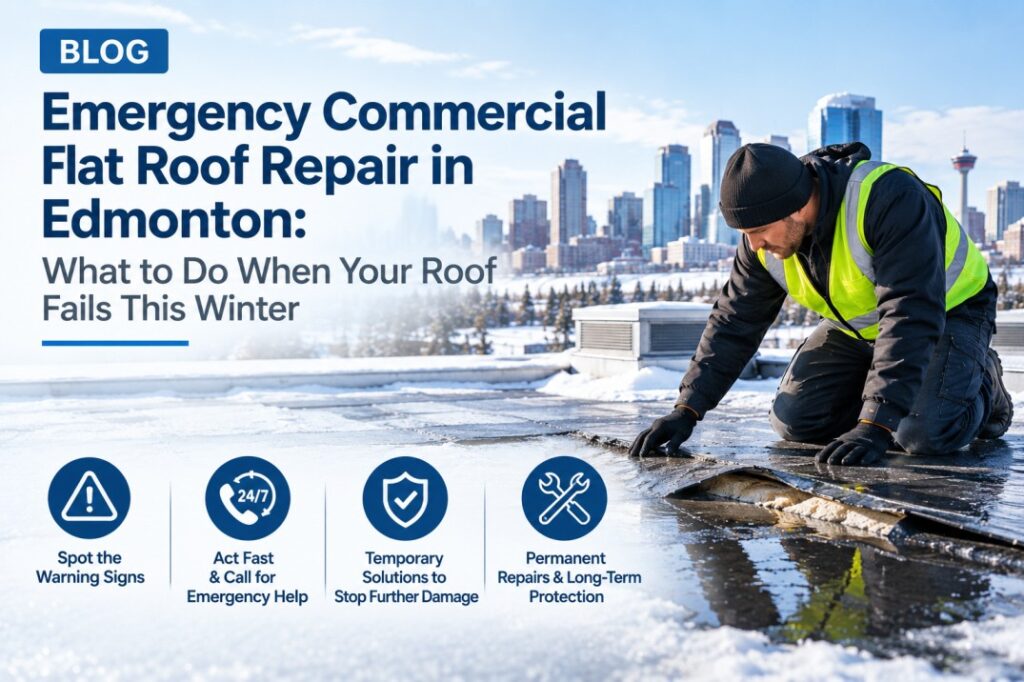
A commercial flat roof leak discovered at 7am on a -22°C Edmonton January morning is not a situation most property managers have a plan for. The interior ceiling is staining. Tenants are calling. Equipment or inventory may be at risk. And finding a roofing contractor who can do meaningful work in those conditions – without making things worse – requires knowing what you’re actually asking for and what’s genuinely possible.
This guide is written for Edmonton commercial property managers facing exactly that situation. It covers what to do in the first 24 hours of a winter roof emergency, what temporary repairs can actually accomplish in cold weather, how permanent repairs are staged when temperatures don’t cooperate, and what decisions you need to make quickly to protect the building and your liability position.
Why Winter Roof Emergencies Are Different in Edmonton
Commercial flat roof emergencies in summer or fall follow a relatively straightforward path: identify the entry point, access the membrane, diagnose the failure, execute the repair, verify waterproofing. In Edmonton’s winter, every one of those steps carries constraints that change the timeline, the scope, and sometimes the method.
Temperature limits on repair materials. SBS modified bitumen torch-on repairs require the membrane substrate to be above a minimum temperature – typically around -5°C with substrate heating, though some cold-weather formulations extend this slightly. Standard seam adhesives for EPDM and TPO termination details have minimum cure temperatures above freezing. Sealants used at flashing terminations have temperature ranges below which they won’t cure correctly or maintain bond strength. Edmonton’s winter frequently breaches all of these thresholds simultaneously.
Moisture and ice on the membrane surface. Any water present on the membrane surface at the time of repair – whether from the leak itself, snowmelt, or condensation – can compromise repair adhesion and must be addressed before membrane work proceeds. On an Edmonton commercial flat roof in January, clearing and drying a membrane repair area in -15°C ambient conditions takes time, equipment, and technique that indoor or warm-weather repairs don’t require.
Reduced access and safety constraints. Snow accumulation and ice formation on an Edmonton commercial flat roof create worksite hazards that require enhanced fall protection measures, snow removal before membrane access, and careful assessment of structural load conditions before crews walk the surface.
Compressed diagnostic windows. In warm weather, infrared moisture scanning works best during specific thermal conditions – typically the hour or two after solar exposure when wet insulation retains heat differently from dry insulation. In Edmonton winter, when the entire roof surface is cold and thermally uniform under snowpack, infrared scanning requires controlled interior-to-exterior temperature differential to produce useful results, and the diagnostic window is narrower.
Understanding these constraints doesn’t mean nothing can be done in winter – it means knowing exactly what can be done well and what needs to wait for conditions to allow permanent repair.
The First 24 Hours: Your Emergency Action Plan
Step 1 – Protect Interior Assets Immediately
Before making any calls, protect what’s at risk inside the building. Move inventory, equipment, documents, and anything moisture-sensitive away from the affected ceiling area. Place collection containers under active drip points. If water is contacting electrical equipment, circuit breakers, or panel infrastructure, shut off power to affected areas and do not restore it until the area has been assessed by an electrician.
Document everything with photographs and video – ceiling staining extent, drip locations, any standing water on floors, and the approximate time you discovered the problem. This documentation is essential for insurance claims, which in Alberta require prompt reporting and evidence of the conditions at discovery.
If you have tenant spaces affected, notify tenants immediately and document that notification. Your liability position as a property manager is significantly better when you can demonstrate prompt response and communication.
Step 2 – Identify the General Failure Zone
Water appearing inside a commercial building in Edmonton almost never marks the actual membrane entry point above. Water enters through a membrane failure – a seam separation, a flashing gap, a puncture – and then travels laterally through the insulation assembly until it finds a path through the vapour barrier or roof deck. The interior stain or drip can be metres away from the actual membrane breach.
This is why “I can see where it’s coming through the ceiling” is not a useful membrane location for a repair contractor. What is useful: which section of the roof is above the affected interior area, when the problem first appeared relative to weather events (snowmelt periods, temperature swings, recent hailstorms), and whether the problem has been worsening or is stable.
Look for contributing clues: Has there been a recent chinook event that caused rapid snowmelt? Has any rooftop equipment been serviced or modified recently? Are there known drainage problems on this section of the roof? This contextual information helps a qualified contractor identify the most likely failure zone before they access the roof in difficult conditions.
Step 3 – Call a Qualified Commercial Flat Roofing Contractor
This step is straightforward in concept and important in practice: call a contractor who specializes in commercial flat roofing systems specifically – not a general roofer whose primary business is residential shingles.
The repair techniques, material specifications, and cold-weather protocols for SBS modified bitumen, TPO, and EPDM flat roofing systems are different from residential repair approaches. A contractor without commercial flat roofing specialization may attempt repairs using inappropriate materials or methods that temporarily mask the leak without addressing the membrane failure – or that fail quickly in Edmonton’s cold-weather conditions.
When you call, be prepared to describe: the building’s roofing system type if known (SBS, TPO, EPDM, BUR/tar and gravel), the approximate age of the roof, the location of the affected interior area, and any recent events that may have contributed (hailstorm, snow load event, recent rooftop equipment work). This information helps the contractor arrive with appropriate materials and equipment for the most likely repair scope.
Silverback Torch On Systems Ltd. provides commercial roof repair and maintenance services across Edmonton and Northern Alberta, including emergency response for active winter roof failures on commercial and industrial buildings.
Step 4 – Request a Diagnostic Inspection Before Repair Work
A qualified contractor’s first step on an Edmonton winter roof emergency should be diagnostic – not immediately patching the most visible surface anomaly. The most common expensive mistake in commercial roof emergency response is patching the wrong location because the entry point was assumed from the interior stain rather than confirmed through roof surface investigation.
A proper emergency diagnostic on an Edmonton commercial flat roof includes roof surface inspection to identify the failure zone, assessment of membrane condition in the suspected area, flashing inspection at parapet walls, equipment curbs, and penetrations, and where conditions allow, infrared or moisture scanning to map water movement through the assembly.
This diagnostic step takes time – typically one to four hours depending on roof size and conditions – but it determines whether the repair address the actual failure or just the most visible symptom.
What Temporary Emergency Repairs Can Actually Accomplish
When ambient temperatures or substrate conditions prevent a permanent membrane repair, a temporary repair can stop active water ingress and protect the building until permanent repair is feasible. It’s important to understand what “temporary” means in this context – and what it doesn’t.
What a winter temporary repair can do:
- Stop active water entry at a confirmed entry point using cold-weather-rated sealant or compatible emergency patch materials
- Protect the membrane from further water ingress at a known failure location
- Buy time until temperatures allow a permanent torch-on, heat-welded, or adhesive repair under appropriate conditions
- Prevent a small failure from becoming a large one through the remaining winter
What a winter temporary repair cannot do:
- Replace the waterproofing integrity of a correctly installed permanent membrane repair
- Address insulation saturation that has already occurred below the membrane breach
- Resolve structural deck deterioration that may have developed from prolonged water infiltration
- Provide the same warranty and long-term performance assurance as a permanent repair
Emergency temporary patches should always be followed by permanent repair as soon as weather conditions allow – typically the first extended period of above-zero temperatures in late winter or early spring. Treating a temporary patch as a permanent solution is one of the most common ways Edmonton commercial property owners extend a manageable problem into an expensive replacement situation.
Cold-Weather Repair Techniques That Work in Edmonton
When temperatures allow limited repair work but aren’t in the optimal range for standard installation, qualified Edmonton commercial roofing contractors use specific cold-weather techniques:
Substrate heating. Before torch-on SBS repairs, the membrane substrate and the repair area are heated using propane or electric heating equipment to bring temperatures above minimum application requirements. This is done carefully to avoid thermal shock to adjacent membrane and to ensure the substrate is dry before repair material is applied. The heated area must maintain temperature through the repair process – which means substrate heating isn’t instantaneous or portable in the way some property managers expect.
Cold-weather SBS membrane formulations. Some SBS modified bitumen repair products are specifically formulated for cold-weather application at lower threshold temperatures than standard torch-on products. These products have shorter effective temperature windows and require careful technique – they are not a universal solution for all Edmonton winter temperatures, but they extend the workable repair window into shoulder conditions that standard products don’t permit.
Temporary sealant products. For flashing termination failures, separation at termination bars, and sealant joint failures that are the confirmed entry point, cold-weather-rated sealants can be applied at temperatures well below standard sealant minimums. These products are appropriate as emergency interventions but are not equivalent to the properly cured, appropriately specified sealant that goes in during a scheduled maintenance visit at optimal temperatures.
Two-stage repair planning. For larger failure scopes where full membrane repair isn’t feasible in winter conditions, qualified contractors plan a two-stage approach: emergency intervention now to stop active ingress, followed by full-scope permanent repair in the spring window. Both stages are documented in writing, and the temporary stage includes explicit scope of what the permanent stage will address.
Insurance Documentation During Winter Roof Emergencies
The actions you take in the first 24 to 48 hours of a commercial roof emergency in Edmonton directly affect your insurance claim position. Commercial property insurance policies in Alberta require:
Prompt reporting. Most policies require reporting of property damage within a specified period – often 24 to 72 hours for active water ingress events. Delayed reporting weakens your claim position and may provide grounds for claim reduction.
Mitigation evidence. Your insurer expects evidence that you took reasonable steps to prevent the damage from worsening after discovery. Moving inventory away from the affected area, placing collection containers, shutting off power to affected electrical areas, and calling a roofing contractor promptly are all mitigation actions that should be documented with timestamps.
Professional assessment documentation. A written assessment from a qualified commercial roofing contractor confirming the failure location, cause, and scope supports your claim significantly more than your own description of the situation. Request a written emergency assessment report from your contractor as part of the emergency response.
Maintenance history. If your building has a documented maintenance history – a series of professional inspection reports confirming the roof was in maintained condition before the emergency – your claim position is meaningfully stronger than if you have no maintenance records. This is one of the long-term reasons why a structured commercial roof inspection program matters beyond the immediate maintenance value it provides.
After the Emergency: Planning for Permanent Repair
Once the immediate winter emergency is stabilized – temporary patch in place, active water ingress stopped, interior protected – the next conversation is planning permanent repair for the first viable weather window.
Spring in Edmonton typically opens an installation window from mid-April onward, when temperatures reliably reach above zero and substrate conditions allow quality membrane work. The specific timing depends on the year – some Edmonton springs open in mid-April, some not until early May. Your contractor should be able to give you a realistic planning horizon based on current seasonal forecasts.
What permanent repair involves depends on what the emergency diagnostic revealed:
- Isolated seam or flashing failure with dry insulation: Targeted membrane repair or flashing replacement at the confirmed failure point. This is the best-case scenario for scope and cost.
- Failure with localized insulation saturation: Membrane repair plus insulation replacement in the saturated zone. The infrared scan from the diagnostic phase maps the extent of the insulation replacement required.
- Multiple failure points or widespread membrane deterioration: Section replacement or – if the membrane system is at or near end of life – full re-roofing assessment to determine whether targeted repairs provide long-term value or whether replacement is the more cost-effective path. Our guide to commercial re-roofing vs. full replacement covers how that decision is made.
For buildings where winter roof emergencies have been recurring – active leaks appearing every winter in the same general area despite previous repairs – the root cause is typically a membrane system that has reached end of life rather than a single addressable deficiency. Repeated emergency repairs on a failing system accumulate costs that approach replacement scope without delivering replacement-level performance.
Preventing the Next Emergency: The Pre-Winter Window
The most effective response to a winter commercial roof emergency in Edmonton is the one that never has to happen. The September and early October window before freeze-up is the critical opportunity to identify and address the deficiencies that become emergency situations after the first hard frost.
Drain clearing and flow testing, membrane surface inspection for blistering and seam edge lifting, flashing sealant assessment and replacement, and a professional inspection with written documentation – these fall maintenance tasks prevent the majority of Edmonton winter commercial roof emergencies that Silverback Torch On Systems responds to.
Property managers who complete a fall professional inspection every year consistently avoid emergency calls in January. Those who defer fall maintenance consistently generate them.
If your Edmonton commercial building’s flat roof hasn’t had a professional fall inspection yet this season – or if you’re managing a winter emergency right now – contact our Edmonton team for emergency response or pre-winter assessment. We serve commercial and industrial buildings across Edmonton and Northern Alberta with COR-certified crews and appropriate cold-weather repair protocols.
Quick Reference: Edmonton Commercial Flat Roof Winter Emergency
| Situation | Immediate Action | What Comes Next |
|---|---|---|
| Active interior drip or staining | Protect assets, document, call contractor | Emergency diagnostic inspection |
| Unknown leak source | Document interior stain location and timing | Surface + infrared diagnostic to find entry point |
| Active leak, -20°C outside | Temporary patch with cold-weather materials | Permanent repair when temperatures allow |
| Tenant space affected | Notify tenant immediately, document | Manage liability exposure with written communication |
| Equipment or inventory at risk | Move or cover immediately | Insurance claim notification within 24–48 hours |
| Flat roof has leaked before in winter | Emergency response + permanent repair plan | Re-roofing assessment if recurring pattern |
| No maintenance records exist | Document current condition | Establish inspection program after repair |
Related reading for Edmonton commercial property owners: