


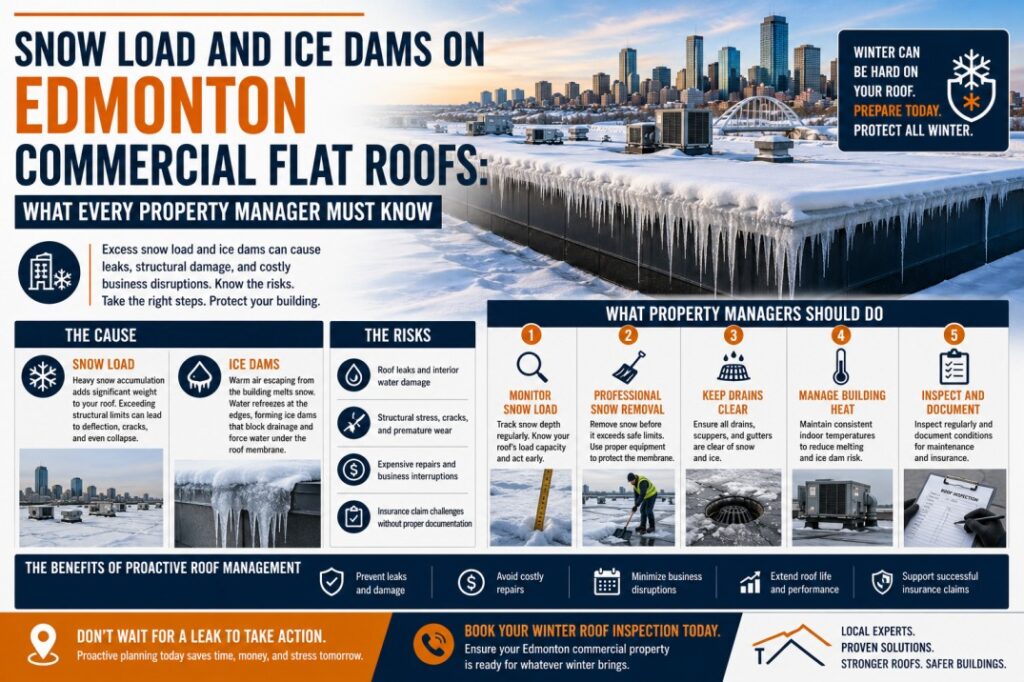
Every Edmonton winter, the same two forces combine to create the most serious structural and waterproofing threats commercial flat roofs face: snow accumulation that adds dead load well beyond what building owners expect, and the freeze-thaw cycling that turns that snow into ice formations capable of blocking drainage, stressing membrane seams, and eventually forcing water into the building.
Neither of these is a fringe risk. Snow load events that approach or exceed structural design limits happen on Edmonton commercial flat roofs every decade. Ice dam formation that blocks internal drains and scuppers happens on Edmonton commercial flat roofs every winter — on almost every building that doesn’t have an active management protocol in place.
This guide explains what Edmonton’s snow load requirements mean for commercial flat roof buildings, how ice dams form and why they’re more dangerous on flat commercial roofs than on residential pitched roofs, the warning signs that demand immediate action, and the management protocols that protect your building through Alberta’s winter season.
What Alberta’s Building Code Says About Snow Load on Commercial Flat Roofs
The National Building Code of Canada — adopted with Alberta-specific amendments — requires that commercial roof structures be designed to support a specified snow load that accounts for Edmonton’s historical snowfall patterns, roof geometry, and site-specific accumulation factors. Edmonton’s ground snow load is approximately 1.9 kilopascals (kPa), which translates to roughly 40 pounds per square foot. The roof design load accounts for factors including roof slope, exposure, and thermal effects, producing a specified roof snow load that certified structural engineers incorporate into building design.
That design load represents what the building was engineered to carry — not a safety margin above normal conditions. The design load is what the roof must handle under code-compliant design. What this means practically is that snow accumulation that approaches design load limits is not comfortable territory — it is the outer boundary of the structure’s engineered capacity under normal conditions.
Three factors can push real-world snow loads on Edmonton commercial flat roofs beyond those design limits:
Drift accumulation. Wind-driven snow doesn’t distribute evenly across a flat roof. It drifts against parapets, behind rooftop mechanical equipment, and against any vertical surface that interrupts airflow. Drift loads can be two to four times the average roof snow load in localized zones — meaning that while the average roof load may be within design parameters, specific drift areas may significantly exceed them. Alberta Building Code requires that roof structures be designed for drift load in these zones, but buildings with rooftop equipment added after original construction may not have had structural design updated to reflect new drift patterns created by that equipment.
Wet snow events. Not all snow weighs the same. Dry powder snow weighs approximately 5 to 15 kilograms per cubic metre. Average seasonal snow weighs 150 to 300 kilograms per cubic metre. Wet, heavy snow — common in Edmonton’s spring snowfall events and during chinook reversals — can weigh 400 to 600 kilograms per cubic metre. A 30-centimetre layer of wet snow on a 10,000 square foot commercial flat roof can add more than 180,000 kilograms of load to the structure. The density of the snow, not the depth, determines the structural risk.
Accumulated seasonal loading. Edmonton winters sometimes produce sustained cold periods where snow doesn’t melt between events, allowing accumulation from multiple storms to build over weeks. A roof that handled the first storm comfortably may approach structural limits as accumulation compounds through a prolonged cold period.
How Ice Dams Form on Commercial Flat Roofs — and Why They’re Different From Residential
Most property managers have heard of ice dams in the context of residential pitched roofs — the ice formations that develop at eaves when heat escaping through the attic melts snow on the upper roof, which then refreezes at the cold eave overhang and creates a dam that backs water under shingles.
Commercial flat roof ice dams work through a different but equally destructive mechanism — and they’re more dangerous because the water they back up has nowhere to drain by gravity.
On Edmonton commercial flat roofs, ice dam formation follows this cycle:
Stage 1: Snow accumulates on the flat roof surface through a cold period. Internal building heat conducts through the roof insulation and warms the membrane surface slightly above ambient temperature. Snow in contact with the warmed membrane surface begins to melt from below, creating a thin layer of liquid water between the snowpack and the membrane.
Stage 2: That meltwater migrates by gravity toward internal drains and scuppers — but the drains themselves are cold, typically at or below ambient air temperature since they’re not in contact with the warmed building interior. Meltwater reaching the drain assembly refreezes when it contacts the cold metal drain bowl and drain body, progressively building an ice formation that eventually blocks the drain completely.
Stage 3: A chinook event or warming trend accelerates snowmelt dramatically. Meltwater that would normally drain through internal drains has no path because those drains are frozen solid. Water ponds on the roof surface, potentially to significant depth if the warming event is prolonged, and that ponded water then finds whatever membrane vulnerability exists — seam lifts, failed flashing sealant, cap sheet micro-fractures — and infiltrates the roofing assembly.
Stage 4: Temperatures drop again after the chinook. The ponded water and any water that infiltrated the membrane assembly freezes. Freeze expansion forces open every entry point that was wet, widening seam separations and driving moisture deeper into insulation. The next warming cycle finds a more compromised membrane than the previous one.
This ratcheting cycle — drainage blockage, ponding, infiltration, freeze expansion, more damage — is why Edmonton commercial flat roofs that experience ice dam formation in their drain assemblies without intervention typically show compounding damage that accelerates through the winter rather than remaining stable.
Warning Signs That Demand Immediate Action
Interior ceiling staining or active drips during winter warming periods. Water appearing on interior ceilings during or immediately after a chinook event is direct evidence that ponded meltwater has found a path through the roofing assembly. This is an emergency — not a “wait for spring” situation. The source must be identified and the entry point temporarily sealed before the next freeze cycle, even if permanent repair waits for warmer weather.
Visible ice formations at roof edges, scuppers, or parapet walls. Ice that has formed at or around roof edge drainage points is visual evidence that drainage is blocked and that meltwater is accumulating somewhere on the roof surface rather than draining. Large icicles hanging from parapet scuppers are not a normal winter feature — they indicate that the scupper is frozen and that water is reaching it without being able to drain.
Unusual sounds from the roof structure. Cracking, popping, or groaning sounds from roof structural elements during periods of heavy snow load are serious warning signs that should be treated as potential structural distress. Any unusual structural sounds warrant immediate professional assessment and may require emergency snow removal before further loading occurs.
Visible deflection of the roof surface. If the flat roof surface shows visible sagging or deflection that wasn’t present before a snow loading event, the structure is experiencing load that may be approaching or exceeding its design capacity. This is an emergency situation requiring immediate professional assessment and likely emergency snow removal.
Water staining on interior walls adjacent to parapet walls. Water migrating behind parapet wall flashings during winter and staining interior walls adjacent to those parapets indicates that the flashing-to-parapet interface has failed under ice pressure and is allowing meltwater to travel behind the roofing assembly.
Snow Management Protocols for Edmonton Commercial Flat Roofs
Know your roof’s design load before winter. If you don’t have access to the structural design documents for your commercial building, consult with a structural engineer before winter to establish what snow depth corresponds to your roof’s design load limit for the specific snow density typical of Edmonton winter events. This gives you a clear threshold for when snow removal becomes necessary rather than requiring judgment under pressure during an active storm.
Prioritize drain access over full snow removal. In most Edmonton commercial flat roof snow events, full roof snow removal is not necessary and carries its own risks — improper snow removal tools can damage the membrane, and redistribution of snow loads during removal can temporarily create worse load concentrations than leaving snow in place. What is almost always necessary is clearing paths to internal drains and scuppers so that meltwater during warming periods has drainage access. Focus removal effort on the two to three metres around each drain assembly, keeping those zones clear throughout the winter.
Never use metal tools on membrane surfaces. Snow removal on Edmonton commercial flat roofs must use plastic snow shovels, purpose-built roof rakes with plastic heads, or similar non-metallic tools that cannot puncture or cut the membrane surface. Metal shovels against SBS modified bitumen, TPO, or EPDM membranes create membrane cuts and punctures that are often not discovered until the following season’s inspection. Leave a minimum of 5 to 8 centimetres of snow on the membrane surface as a buffer layer — you are removing excess load, not exposing the membrane.
Address drift zones specifically. Drift accumulation zones against parapets and rooftop equipment should be prioritized for removal before average roof areas. These zones carry disproportionate load and are also the areas where ice dam formation is most common due to the sheltered microclimate they create.
Implement drain heating where chronic icing occurs. Flat roofs on Edmonton commercial buildings that experience recurring drain icing can benefit from self-regulating heat trace cables installed in drain bodies and the first two to three metres of drain piping below the roof surface. These maintain drain temperatures above freezing without continuous high energy draw, preventing the drain blockage that initiates the ice dam cycle. Installation is best done as part of a planned commercial roof repair and maintenance project rather than as an emergency response.
Why Insulation Quality Determines Ice Dam Risk
The rate at which building heat conducts through the roof assembly and warms the membrane surface from below is directly determined by the insulation specification beneath the membrane. A well-insulated commercial flat roof in Edmonton — meeting or exceeding the current Alberta Building Code minimum of RSI 3.52 (approximately R-20) — maintains a colder membrane surface than an under-insulated roof, which reduces the rate of snow melt from below and slows the ice dam formation process.
Older Edmonton commercial buildings that were constructed under previous code standards with insulation values well below current minimums are disproportionately prone to ice dam formation because their roof surfaces are warmer relative to ambient temperature. This is one of the cases where bringing insulation up to current code during a commercial re-roofing project delivers benefits beyond energy savings — it directly reduces the ice dam risk that generates winter maintenance emergencies.
Post-Winter: What Snow Load Season Does to Your Membrane
When Edmonton’s snowpack finally clears in spring and your commercial flat roof surface becomes accessible, the evidence of what the winter’s snow load and ice dam cycles did to the membrane system is ready to be found — or to get worse through spring rain season if no one looks.
A professional commercial roof inspection after winter should specifically assess:
- Seam conditions at parapet wall bases and behind rooftop equipment where drift loads concentrated
- Drain assembly condition including clamping ring integrity and bowl seating after freeze-thaw movement
- Flashing condition at all parapet wall terminations where ice formation may have displaced flashings
- Membrane surface condition for any areas where snow removal tools made contact with the surface
At Silverback Torch On Systems Ltd., we specialize in commercial flat roofing in Edmonton and provide both pre-winter preparation assessments and post-winter inspection services with written reports and photographic documentation. If your Edmonton commercial building has experienced a heavy snow season, ice dam formation at drains, or any of the warning signs described in this guide, contact our team to schedule a professional assessment before spring rain season adds the next layer of load to a winter-stressed membrane.
Quick Reference: Edmonton Commercial Flat Roof Snow & Ice Management
| Situation | Action Required | Timing |
|---|---|---|
| Snow depth approaching design load | Professional snow removal assessment | Immediately |
| Drain areas blocked by snow accumulation | Clear 2-3m radius around each drain | Before next warm period |
| Visible icicles at scuppers or parapet edges | Professional drain clearing and assessment | Within 24-48 hours |
| Interior ceiling staining during chinook | Emergency professional assessment | Same day |
| Unusual roof structure sounds | Stop building use, call structural engineer | Immediately |
| Post-winter spring inspection | Professional membrane + drain assessment | April-May |
| Recurring annual drain icing | Heat trace installation assessment | Summer/fall |
Related reading for Edmonton commercial property owners:
- Ponding Water on Commercial Flat Roofs in Edmonton: Causes, Risks, and Real Solutions
- Hail Damage on Commercial Flat Roofs in Edmonton: How to Assess, Document, and Respond
- Commercial Roof Insulation in Edmonton: What Every Property Owner Needs to Know
- How Edmonton’s Extreme Seasons Affect Your Commercial Roof