


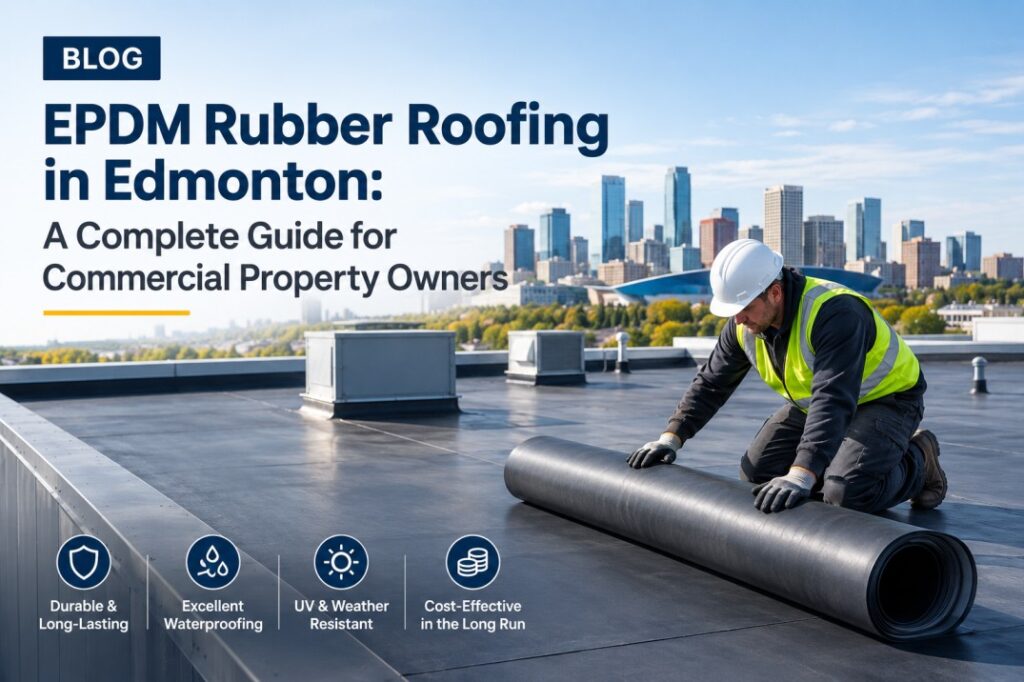
When Edmonton commercial property owners start comparing flat roofing systems, EPDM — ethylene propylene diene monomer, or simply “rubber roofing” — comes up consistently as a cost-effective and time-tested option. It has been used on commercial and industrial flat roofs across North America since the 1960s, carries one of the longest track records of any single-ply membrane system, and is available at a price point that makes it attractive when budget is a primary consideration.
But EPDM in Edmonton is not the same conversation as EPDM in Ottawa, Vancouver, or Phoenix. Alberta’s climate — with its 200-plus annual freeze-thaw cycles, -35°C winter extremes, summer hailstorms, and UV-intense long days — creates specific performance conditions that affect how EPDM behaves over its service life. Understanding where EPDM performs well and where it carries limitations specific to Edmonton’s market is essential before making a roofing system decision on a major commercial property.
This guide covers everything Edmonton commercial property owners and facility managers need to know about EPDM rubber roofing — what it is, how it’s installed, where it works best, where its limitations show up in Alberta’s climate, what it costs in 2026, and how to maintain it properly.
What Is EPDM Roofing?
EPDM stands for ethylene propylene diene monomer — a synthetic rubber compound formulated specifically for use as a flat roofing membrane. The material is manufactured from a polymer blend of ethylene, propylene, and a small percentage of diene monomer, producing a highly elastic membrane with strong resistance to UV radiation, ozone, and weathering.
EPDM is manufactured in large sheet rolls, typically in black or white (white is available as an Energy Star cool-roof option at premium cost), and comes in membrane thicknesses of 45-mil, 60-mil, and 90-mil. Sheet widths range from narrow rolls of 1.5 metres to very wide sheets of 15 metres or more — a characteristic that distinguishes EPDM from most other commercial flat roofing membranes and has a direct bearing on its seam management advantages.
The system has been commercially available since the early 1960s, giving it over 60 years of documented performance history on commercial and industrial buildings — the longest track record of any currently active single-ply roofing system. According to the National Roofing Contractors Association, EPDM accounts for approximately 25 to 30 percent of the low-slope commercial roofing market across North America, making it one of the most widely installed systems on the continent.
How EPDM Is Installed
EPDM membrane can be installed using three different methods, each with different performance characteristics and appropriate applications:
Fully Adhered Installation
The membrane is bonded directly to the roof substrate using a solvent-based bonding adhesive applied to both the membrane underside and the insulation board surface. After a specified open time that allows solvent evaporation, the membrane is carefully rolled into the adhesive and pressed firmly to create a continuous bond across the full membrane area.
Fully adhered EPDM installation delivers the best wind uplift resistance and the best performance in Edmonton’s climate of the three methods — the continuous adhesive bond eliminates the air movement beneath the membrane that ballasted and mechanically fastened systems allow. The limitation in Edmonton’s market is the temperature sensitivity of bonding adhesives: most EPDM bonding adhesives require a minimum application temperature of +10°C and a substrate temperature above freezing. This restricts the Edmonton installation window to May through September for full adhesive installation — a narrower window than SBS torch-on, which can be applied at lower ambient temperatures with appropriate heating.
Mechanically Fastened Installation
The membrane is attached to the roof deck using factory-engineered fasteners and plates through the membrane and insulation into the structural deck. Seams between adjacent membrane sheets are lap-welded using EPDM seam tape.
Mechanically fastened EPDM is faster and less temperature-sensitive to install than fully adhered — fastening can be done in colder conditions than adhesive requires. However, in Edmonton’s climate, mechanically fastened EPDM carries a specific performance limitation: the exposed fastener heads beneath the membrane create thermal bridging points that experience differential movement relative to the surrounding membrane through 200-plus annual freeze-thaw cycles. Over time, this fastener movement can cause membrane fatigue at the fastener locations — a failure mode that is less common on fully adhered systems where thermal movement is distributed across the full membrane area rather than concentrated at fastener points.
Ballasted Installation
Loose-laid EPDM is placed over the insulation and held in place by rounded river stone ballast (typically 38 to 50mm diameter) at a rate of 50 kilograms or more per square metre. Ballasted EPDM is the fastest and least expensive installation method — no adhesive, no fasteners, just membrane and ballast.
Ballasted EPDM is relatively uncommon in Edmonton’s commercial market for two specific reasons. First, the ballast load adds 50 to 70 kilograms per square metre to the roof dead load — a meaningful structural addition that older Edmonton commercial buildings with established maximum roof load capacities may not accommodate. Second, in Edmonton’s chinook events, rapid temperature swings can cause differential movement between the loose-laid membrane and the ballast above it, and strong chinook wind gusts have been known to shift ballast on exposed Edmonton roof areas in ways that compromise membrane protection.
EPDM Performance in Edmonton’s Climate: Where It Excels
Cold Temperature Flexibility
EPDM’s rubber composition gives it genuine cold-temperature flexibility — the material remains elastic and bendable at temperatures well below -40°C, which meets and exceeds Edmonton’s recorded minimum temperatures. This cold flexibility is one of EPDM’s most legitimate performance advantages in Alberta and is the reason the system has been used on northern Canadian commercial buildings for decades.
Unlike some TPO formulations — particularly entry-level 45-mil membranes — that can become rigid and prone to cracking below -20°C, EPDM maintains its physical properties through Edmonton’s coldest nights without the brittleness risk. This makes EPDM membrane itself one of the more cold-climate-appropriate materials available for Edmonton flat roofing applications.
UV and Ozone Resistance
EPDM has exceptional resistance to UV radiation and ozone degradation — significantly better than standard bitumen-based systems. The synthetic rubber formulation does not oxidize under UV exposure the way that bitumen does, which means EPDM surfaces maintain their physical properties over decades of UV exposure without the alligatoring and surface brittleness that characterize aging modified bitumen or BUR systems.
Edmonton’s summer UV intensity — driven by the city’s latitude and relatively low average cloud cover during long summer days — is one of the factors that advances membrane aging on tar and gravel and some modified bitumen systems. EPDM is largely unaffected by this UV load, which contributes to its long documented service life.
Large Sheet Size and Seam Count Reduction
On very large-footprint commercial or industrial flat roofs, EPDM’s wide sheet format — available up to 15 metres in some product lines — allows significantly fewer seams than narrower SBS or TPO roll widths. Since seams are the primary water entry risk on any flat roofing system, reducing total seam linear footage on a large roof has genuine waterproofing value.
For Edmonton industrial buildings with 50,000 square feet or more of roof area, EPDM’s seam count advantage is worth evaluating against the seam adhesion limitations described below. The calculation depends on the specific building’s geometry, penetration count, and the contractor’s documented experience with EPDM installation in Alberta’s climate.
Proven Long-Term Track Record
EPDM’s 60-plus year documented history on commercial buildings across North America gives property owners a performance record that newer membrane formulations cannot match. Many Edmonton commercial buildings with EPDM systems installed in the 1990s and early 2000s are still in service — demonstrating that well-installed, properly maintained EPDM in Alberta’s climate can reach 25 to 30 years of reliable performance.
EPDM Limitations Specific to Edmonton’s Climate
Adhesive Seam Vulnerability Under Freeze-Thaw Cycling
This is the most significant performance limitation of EPDM in Edmonton’s market, and it’s important to understand clearly rather than minimize.
EPDM seams — whether bonded with liquid adhesive or EPDM seam tape — are not heat-welded like SBS torch-on or TPO seams. They rely on a chemical adhesive bond between membrane surfaces that must maintain its bond strength through cumulative stress from repeated thermal expansion and contraction.
Edmonton’s 200-plus annual freeze-thaw cycles place more cumulative stress on EPDM adhesive seam bonds than virtually any other Canadian market. Each freeze-thaw cycle slightly stresses the adhesive bond. Over years and decades, this cumulative stress advances toward adhesive seam separation — particularly at the most geometrically stressed points: inside and outside corners of equipment curbs, pipe penetration collar edges, and parapet wall base transitions where the membrane changes direction.
Industry experience with EPDM on Edmonton commercial buildings shows that adhesive seam separation at penetration details — not membrane field failures — is the dominant failure mode, typically emerging between years 15 and 25 of the system’s life. Buildings with high penetration counts (many equipment curbs, pipe stacks, and drain assemblies) carry more cumulative seam detail risk than buildings with simple, low-penetration roof geometries.
This is why EPDM performs best in Edmonton on large-footprint buildings with relatively few penetrations, where the seam count reduction advantage is maximized and the penetration detail count that drives seam failure risk is minimized. Compare this to our detailed analysis in the SBS vs TPO vs EPDM comparison guide for Edmonton.
Adhesive Temperature Window Restricts Installation Season
The bonding adhesives used in fully adhered EPDM installation have minimum temperature requirements — typically +10°C ambient and above-freezing substrate — that restrict safe Edmonton installation to May through September in most years. This is a narrower productive installation window than SBS torch-on, which experienced Edmonton crews can install at lower ambient temperatures with appropriate substrate heating.
For planned EPDM replacement or re-roofing projects in Edmonton, project timing must account for this window. October EPDM installations — common for projects that started planning late — carry adhesive cure quality risk that September SBS installations don’t.
Black Membrane Surface and Heat Absorption
Standard EPDM membrane is black — a characteristic that absorbs solar radiation rather than reflecting it. For Edmonton commercial buildings where summer cooling loads are significant — cold storage facilities, server rooms, food processing buildings — a black EPDM roof surface contributes to rooftop heat build-up that increases mechanical cooling demand during summer.
White EPDM is available at a cost premium that brings it closer to TPO pricing, partially offsetting the energy performance concern. However, for Edmonton buildings where summer solar gain is a meaningful operational cost factor, TPO’s reflective surface typically delivers better energy performance at comparable or lower total cost than white EPDM.
EPDM Roofing Cost in Edmonton — 2026 Ranges
EPDM rubber roofing installation costs in Edmonton for 2026 — including fully adhered membrane installation, insulation to current Alberta Building Code minimum (RSI 3.52 / R-20), standard drain and flashing details, and project management — run approximately:
| Project Scope | 2026 Edmonton Cost Range |
|---|---|
| EPDM re-roofing overlay (over sound existing substrate) | $8 – $12 per square foot |
| Full EPDM replacement (tear-off, insulation, new membrane) | $11 – $16 per square foot |
| 90-mil EPDM premium installation (full replacement) | $14 – $19 per square foot |
| EPDM patch repair (per repair event, minor) | $400 – $900 |
| EPDM seam repair at penetration detail | $600 – $1,500 per detail |
These ranges compare to SBS modified bitumen at $9 to $16 per square foot for full replacement and TPO at $10 to $17 per square foot — placing standard EPDM at a competitive price point while 90-mil premium EPDM approaches TPO territory.
The key cost variable in EPDM projects is membrane thickness. 45-mil EPDM is under-specified for Edmonton’s climate and should not be accepted on any commercial project regardless of the cost advantage it appears to offer. The minimum appropriate specification for Edmonton commercial EPDM is 60-mil, with 90-mil warranted for industrial applications or buildings in high-hail-exposure locations.
For a complete breakdown of commercial flat roofing costs across all systems, see our commercial flat roof repair and replacement cost guide for Edmonton.
EPDM Maintenance Requirements in Edmonton
Maintaining an EPDM flat roof on an Edmonton commercial building requires attention to the specific failure modes that Edmonton’s climate accelerates — primarily at seam details and penetration flashings.
Biannual professional inspections remain the appropriate maintenance cadence for Edmonton EPDM systems — one fall visit before freeze-up and one spring visit after snowmelt, following the same timing rationale as other flat roofing systems. A professional commercial roof inspection for an EPDM building should specifically include physical adhesive bond testing at all seam edges and penetration collar edges — not just visual assessment — because adhesive bond degradation is not reliably visible until the seam has already separated.
Sealant maintenance at termination bars. EPDM membrane terminates at parapet walls and roof edges under metal termination bars with sealant covering the bar edge. This sealant weathers in Edmonton’s climate over 5 to 8 years, hardening and developing hairline cracks that allow water to migrate behind the termination. Fall maintenance should include sealant assessment and replacement at all termination bar edges and equipment curb top edges.
Penetration collar inspection and re-bonding. EPDM penetration flashings at equipment curbs and pipe penetrations are the highest-maintenance details on Edmonton EPDM roofs. Annual close inspection of every penetration collar — including probe testing at collar edges — identifies early-stage adhesive bond separation before it admits water. Re-bonding at collar edges where early separation is identified is a straightforward repair; addressing the interior water damage from a collar that has separated completely is not.
Post-winter drain clamping ring check. As with all flat roofing systems in Edmonton, drain clamping ring torque check after winter is warranted — freeze-thaw cycling loosens clamping rings from their installation torque over multiple seasons. For a comprehensive commercial roof repair and maintenance program covering these elements on your Edmonton EPDM building, contact our team.
When EPDM Makes Sense for Your Edmonton Commercial Building
EPDM rubber roofing is a legitimate and competitive choice for Edmonton commercial buildings in specific scenarios. It is the right conversation to have when:
The building has very large roof footprint with relatively few penetrations. A 100,000 square foot distribution facility with 8 to 10 equipment curbs and 15 to 20 pipe penetrations gets EPDM’s seam count reduction benefit maximized while carrying relatively low penetration detail seam risk.
The contractor has documented, verifiable EPDM installation experience in Alberta. Cold-weather adhesive technique, proper open time management, and Edmonton-specific penetration detail practice are not generic skills — they require specific experience in Alberta’s installation conditions. Request examples of completed EPDM projects in Edmonton with contact references before accepting a proposal.
Project timing falls within the May through September installation window. EPDM projects planned and awarded in spring for summer installation have the full adhesive cure benefit and the strongest long-term bond quality.
Budget is the primary constraint and long-term seam maintenance is planned. EPDM at 60-mil or 90-mil specification with a structured biannual maintenance program that includes penetration collar inspection is a cost-effective long-term roofing strategy for the right building type.
EPDM is a less appropriate choice when the building has high penetration counts, when installation timing falls into late October or beyond, when white reflective surface is required for energy performance on a cooling-load-intensive building, or when the available Edmonton contractor pool for EPDM has limited documented Alberta-specific installation experience.
Getting an EPDM Assessment for Your Edmonton Property
Silverback Torch On Systems Ltd. assesses EPDM as part of our system evaluation process for Edmonton commercial buildings — evaluating whether it or SBS modified bitumen or TPO is the right fit based on each building’s footprint, penetration count, budget, timing, and long-term maintenance intentions.
We specialize in commercial flat roofing in Edmonton and provide honest system recommendations based on what performs best for the specific building — not what’s easiest to install or most profitable to propose. If your Edmonton commercial building’s flat roofing system needs replacement or your existing EPDM system needs assessment or repair, contact our Edmonton team for a free on-site evaluation.
Quick Reference: EPDM Rubber Roofing in Edmonton
| Factor | EPDM Performance in Edmonton |
|---|---|
| Cold temperature flexibility | Excellent — elastic below -40°C |
| Freeze-thaw seam performance | Adhesive seams accumulate stress — inspection critical |
| UV resistance | Excellent — no oxidation like bitumen systems |
| Hail resistance | Good — rubber deforms and recovers on impact |
| Energy performance (black) | Absorbs solar heat — not a cool roof |
| Energy performance (white) | Good — comparable to TPO at higher cost |
| Wide sheet seam reduction | Strong advantage on large footprints |
| Installation temperature window | Narrower than SBS — May to September preferred |
| 2026 Edmonton cost range | $8 – $16 per sq ft (60-mil, re-roofing to replacement) |
| Typical service life (Edmonton) | 20 – 30 years with proper maintenance |
| Best Edmonton application | Large industrial/warehouse, low penetration count |
| Maintenance priority | Biannual penetration collar and seam inspection |
Related reading for Edmonton commercial property owners:
- SBS vs TPO vs EPDM: Which Flat Roof System Is Right for Your Edmonton Commercial Building?
- Commercial Flat Roof Repair and Replacement Cost in Edmonton: A 2026 Guide
- Commercial Flat Roof Flashing Failures in Edmonton: Causes, Signs, and How to Fix Them
- Industrial Roofing in Edmonton: What Facility Managers Need to Know