


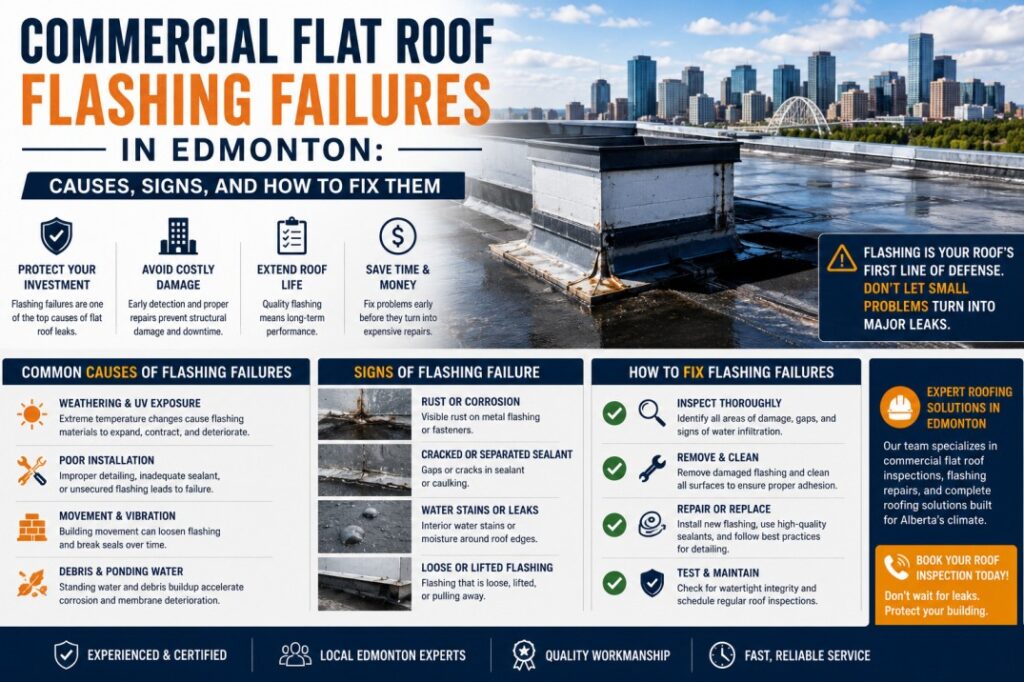
If your Edmonton commercial building has a flat roof that’s leaking, there is a good chance the water is not coming from the middle of the membrane. It’s coming from the edges. From the walls. From the equipment curbs. From the drain collars. From anywhere the flat membrane transitions to a vertical surface.
These transitions are handled by flashings — and flashing failure is the single most common cause of commercial flat roof leaks in Edmonton. Industry estimates consistently show that 70 to 80 percent of flat roof leaks originate at flashing details rather than in open membrane areas. Despite this, flashing receives far less attention than membrane systems in most commercial roof discussions, and far less maintenance than it deserves.
Understanding why commercial flat roof flashings fail in Edmonton’s climate, how to identify failure before it becomes a leak, and what the correct repair approach looks like is essential knowledge for any property manager responsible for a commercial building in Alberta.
What Flashings Are and Why They Matter So Much
Flashings are the waterproofing details that manage the transition wherever a flat roof membrane meets a vertical or non-membrane surface. They are installed at:
- Parapet walls — the low walls at the perimeter of most flat commercial roofs
- Rooftop equipment curbs — the raised frames that support HVAC units, exhaust fans, and makeup air units
- Pipe penetrations and vent stacks — where mechanical and plumbing pipes exit through the roof membrane
- Drain collars and sumps — where internal roof drains connect membrane to drain body
- Expansion joints — where the building structure allows for thermal movement
- Roof-to-wall intersections — where the flat roof meets a taller building element
At each of these locations, the flat membrane cannot continue uninterrupted — it must terminate against another material, turn a corner, or seal around a penetration. The flashing is what makes that termination waterproof.
The challenge is that flashings operate in a mechanically different environment than the open membrane field. The membrane in the middle of the roof expands and contracts with temperature changes as a continuous sheet, distributing thermal stress across a large area. Flashings at parapet walls, curb edges, and penetrations are constrained between two different materials — the membrane and the vertical surface — that expand and contract at different rates and in different directions. Over time, this differential movement is what causes flashings to fail.
In Edmonton’s climate — where annual temperature swings exceed 65 degrees Celsius and freeze-thaw cycles occur more than 200 times per year — that differential movement is relentless. Edmonton flashings work harder than flashings in almost any other Canadian city, which is why they need more consistent attention.
Why Edmonton’s Climate Makes Flashing Failures More Likely
Three specific aspects of Edmonton’s climate drive flashing failures at rates that milder markets don’t experience:
Freeze-thaw cycling. Each time temperatures cross the freezing threshold, metal flashings, sealant joints, and membrane terminations expand and contract. Metal counter-flashings expand when warmed by solar radiation and contract in cold. The sealant that fills the gap between flashing components fatigues through repeated cycling — softening in summer heat, hardening and cracking in winter cold. After five to eight years of Edmonton winters, most sealant joints at flashing details have lost enough elasticity to develop hairline cracks during cold snaps. Those cracks admit water during the next rain or melt event.
Chinook wind pressure. Edmonton’s chinook events produce rapid, strong wind events that apply lateral pressure to parapet wall flashings and counter-flashings. Metal coping at parapet tops and counter-flashings secured against wall surfaces are vulnerable to wind uplift during chinook gusts, particularly at corners where wind pressure concentrates. Flashings that were properly secured at installation can develop lift at their edges after repeated chinook events work their fasteners loose over years.
Ice formation at termination edges. Where the flat membrane surface meets a parapet wall or equipment curb at ground level, meltwater from the roof surface accumulates during temperature fluctuations. When that water refreezes, it forms ice at exactly the flashing termination line — the most mechanically sensitive point of the detail. Ice expansion at flashing termination edges forces open gaps that weren’t present before and widens existing ones, creating direct water pathways into the wall assembly or under the membrane.
Types of Commercial Flat Roof Flashings and How Each Fails
Parapet Wall Flashings
Parapet wall flashings are the membrane details that extend from the flat roof surface up the interior face of the perimeter parapet wall. On SBS modified bitumen roofs, these are typically SBS membrane strips heat-welded to the field membrane and running up the parapet face to a height of at least 200mm above the finished roof surface.
Parapet wall flashings fail through four mechanisms specific to Edmonton commercial buildings:
Termination lap separation. The top edge of the parapet flashing where it terminates against the parapet wall is the highest-stress point in the detail. This edge is typically secured with a metal termination bar and sealant. Over time in Edmonton’s freeze-thaw environment, the sealant at the termination bar fails, the bar fasteners work loose, and the flashing edge lifts away from the wall — creating a gap where wind-driven rain and melt water enter directly behind the membrane. This is the most common parapet flashing failure mode in Edmonton and the one most easily caught in professional inspections.
Base weld failure at the membrane-to-flashing transition. Where the vertical parapet flashing welds to the horizontal field membrane, thermal movement in two different planes — horizontal membrane expansion and vertical flashing movement — stresses the heat-welded joint. On older SBS systems in Edmonton, this base transition is often one of the first areas to show seam lifting or separation during post-winter inspections.
Counter-flashing failure at coping. Many Edmonton commercial parapet walls have metal coping covering the top of the parapet, with metal counter-flashings lapping down over the top of the SBS parapet wall flashing. The seams at coping joints and corners are vulnerable to Edmonton’s freeze-thaw cycling and chinook wind events. Open coping seams at corners — where water enters the top of the parapet and runs behind the counter-flashing — are responsible for a significant proportion of the interior wall staining that property managers initially attribute to roof membrane failures.
Parapet wall movement cracking. Edmonton’s frost-heave in clay-heavy soils can cause slow differential movement in parapet wall structures that gradually stretches the SBS membrane flashing attached to them. This type of failure develops over years rather than seasons and typically appears as diagonal cracking in the parapet flashing running from corners and intersections.
Equipment Curb Flashings
Every rooftop HVAC unit, exhaust fan, makeup air unit, and rooftop mechanical component sits on a raised curb that penetrates the flat roof membrane. The flashing at each curb base is the waterproofing detail that connects the curb to the surrounding membrane system.
Equipment curb flashings on Edmonton commercial flat roofs fail most commonly at two points:
Curb corner details. The inside and outside corners where the flat flashing membrane turns from one face of the curb to another are the most geometrically complex and mechanically stressed points in the detail. Factory-prefabricated corner pieces should be used rather than field-cut attempts to mitigate this geometry, but not all Edmonton roofing installations include them. Corners that were field-cut and patched rather than properly prefabricated show stress cracking and separation years before the straight sections of the same curb flashing fail.
Sealant at curb terminations. The top termination of the curb flashing — where it meets the curb wall above the membrane level — is typically sealed with caulk or mastic sealant. In Edmonton’s climate, this sealant requires periodic replacement — typically every five to eight years — to maintain its waterproofing function. Deferred maintenance on curb termination sealant is one of the most common and most preventable sources of commercial flat roof water infiltration in Edmonton.
Pipe Penetration Flashings
Where mechanical and plumbing pipes exit through the flat roof membrane, rubber pipe boots, lead collars, or SBS pitch pans seal the gap between pipe and membrane. These details fail through:
Pipe boot cracking. EPDM rubber pipe boots are vulnerable to UV degradation over time, developing surface cracking that allows water infiltration around the pipe. Edmonton’s UV exposure during long summer days accelerates this degradation compared to less sunny climates.
Pitch pan sealant shrinkage. Older Edmonton commercial buildings with pitch pan details around pipe penetrations require periodic sealant maintenance — the pourable sealant or pitch material in these pans shrinks over time and pulls away from pipe walls, creating a gap at exactly the point where water is most likely to pond.
Pipe movement stress. Mechanical pipes that experience significant thermal expansion — steam pipes, heated supply lines — move independently of the membrane flashings surrounding them. Over Edmonton’s temperature range, this movement can work pipe flashing details loose at their edges.
Drain Collar Flashings
Where internal roof drains connect to the flat membrane, drain clamping rings compress the membrane to the drain body, creating the waterproof seal between membrane and drain. Drain collar flashings fail through:
Loose clamping rings. Edmonton’s freeze-thaw cycles work clamping ring fasteners loose over time. A clamping ring that loses even slight compression against the membrane creates a gap through which water bypasses the drain entirely — travelling between the membrane and drain body rather than into the drain opening. This failure mode is difficult to detect visually and is reliably identified only through professional inspection that checks clamping ring torque.
Drain body displacement. In older Edmonton commercial buildings, drain bodies can shift slightly in their sleeve connections through years of thermal cycling. Even a few millimetres of displacement can break the waterproof seal between drain flange and membrane, creating an annular gap around the drain that allows water to enter the roof assembly rather than exit through the drain.
How to Identify Flashing Failures Before They Become Leaks
The most important characteristic of commercial flat roof flashing failures is that they are almost always detectable before they cause interior water infiltration — if someone is looking for them systematically. By the time a flashing failure causes a visible interior ceiling stain, the water has typically been travelling through the building envelope for weeks or months.
During professional roof inspections, every flashing termination should be physically examined — not just visually scanned from a distance. Lift testing at termination bar edges, probe testing at parapet flashing base welds, physical assessment of sealant condition at curb terminations and pipe penetrations, and torque checking of drain clamping rings all identify failures before they admit water.
Following Edmonton hailstorms, equipment curb corners and pipe boot flashings should receive close inspection because hail impacts near these details can displace or crack flashings that appear intact from a distance. Our detailed guide on hail damage assessment for Edmonton commercial flat roofs covers this post-storm process in full.
After Edmonton winters, parapet wall flashing terminations and drain collar flashings are the highest-priority inspection items. Freeze-thaw cycling through the winter advances all of the failure modes described above, and spring inspection is the first opportunity to identify and repair damage before spring rain season applies water pressure to compromised details.
Water staining patterns on interior walls and ceilings provide indirect evidence of flashing failure locations. Water migrating behind parapet wall flashings typically shows as staining on interior walls adjacent to exterior walls near the roofline — not as ceiling staining directly below the roof membrane. Water entering through equipment curb flashings typically appears as ceiling staining in a pattern that follows the curb perimeter. Understanding these pattern signatures helps property managers communicate leak locations to roofing contractors more precisely than “somewhere on the roof.”
Repairing vs. Replacing Flashing on Edmonton Commercial Flat Roofs
Not every flashing deficiency requires full replacement — but the distinction between repairable conditions and those requiring full replacement is important because misidentifying a replacement condition as a repair opportunity leads to repeat failures at the same location.
Repairable conditions include: failed sealant at termination bars or curb tops (sealant replacement, not flashing replacement); minor edge lifting at parapet flashing terminations where the base weld is intact; loose drain clamping rings that haven’t yet caused membrane displacement; cracked pipe boots where the flashing structure beneath is sound; and isolated seam separations at curb corners less than 150mm in length.
Replacement conditions include: parapet flashing where the base weld to the field membrane has fully separated over a significant run; equipment curb flashings that have been patched repeatedly at the same corner without sustained success; drain flashing assemblies where the drain body has displaced sufficiently to break the clamping ring seal; and any flashing detail that has been allowing water infiltration long enough that moisture has entered the wall assembly or insulation beneath.
When Edmonton commercial buildings undergo commercial re-roofing or full roof replacement projects, all flashing details at parapet walls, equipment curbs, penetrations, and drains should be replaced as part of the project scope — not carried over from the existing system. Reusing old flashings with a new membrane system creates the weakest links in the new installation at exactly the points historically most vulnerable to failure.
The Maintenance Schedule That Prevents Most Flashing Failures
The majority of commercial flat roof flashing failures in Edmonton that cause interior water damage are preventable through a consistent maintenance schedule. The specific maintenance tasks that address flashing condition are straightforward and far less expensive than the consequences they prevent.
Fall maintenance (September–October):
- Replace failed or hardened sealant at all termination bar edges and curb top terminations
- Inspect all parapet flashing edges for lifting and re-adhere any lifted sections before freeze-up
- Check drain clamping ring torque and re-torque any loose rings
- Inspect all pipe boot conditions and replace cracked EPDM boots before winter
Spring maintenance (April–May):
- Inspect all parapet wall flashing terminations for freeze-thaw induced separation
- Probe all base welds at parapet flashing-to-membrane transitions for integrity
- Inspect equipment curb corners for any hail or freeze-thaw induced cracking
- Check drain assembly displacement and confirm proper seating
A professional commercial roof repair and maintenance program addresses all of these items biannually — which is the correct frequency for Edmonton’s climate conditions given the rate at which freeze-thaw cycling advances flashing deterioration.
Getting a Professional Flashing Assessment for Your Edmonton Commercial Building
If your Edmonton commercial building has experienced any of the following, a professional flashing assessment is warranted regardless of when the last general inspection occurred:
- Interior staining on walls adjacent to exterior perimeter walls near the roofline
- Visible lifting at parapet wall coping edges or termination bar locations
- More than five years since flashing sealants were last replaced
- Recurring leaks near rooftop mechanical equipment despite membrane repair
- Any rooftop equipment installed or modified by a non-roofing contractor
A dedicated flashing assessment by a qualified commercial roof inspector covers every flashing detail on the roof surface, provides photographic documentation of each deficiency found, and delivers a prioritized repair scope that distinguishes between immediate repair requirements and items appropriate for scheduled maintenance.
At Silverback Torch On Systems Ltd., we specialize in commercial flat roofing in Edmonton — including flashing assessment, sealant replacement, full parapet and curb flashing replacement, and ongoing maintenance programs designed around Edmonton’s specific climate demands. If your commercial building’s flat roof is showing any of the warning signs described above, contact our Edmonton team for a professional assessment before the next rain or freeze event turns a repairable flashing condition into an interior water damage event.
Quick Reference: Flashing Failure Signs by Location
| Flashing Location | Common Failure Signs | Action |
|---|---|---|
| Parapet wall termination bar | Lifted edge, cracked sealant, water staining on adjacent interior wall | Reseal or re-adhere; replace if base weld failed |
| Parapet coping joints/corners | Open seams, icicle formation in winter | Re-seal seams; inspect counter-flashing |
| Equipment curb corners | Cracking, separation, repeated leak at same unit | Corner piece replacement |
| Curb top sealant termination | Cracked or missing sealant, water near curb interior | Sealant replacement |
| Pipe penetration boots | Surface cracking, shrinkage gap at pipe wall | Boot replacement |
| Drain clamping ring | Ring visible movement, leak pattern following drain perimeter | Re-torque or full drain collar replacement |
Related reading for Edmonton commercial property owners: