


Skylights bring daylight into warehouses, retail stores, offices and industrial buildings across Edmonton. They can cut lighting costs and make large interior spaces brighter. But on a commercial flat roof, every skylight is also a hole in the roof surrounded by flashing, seals and a curb. All of those can fail.
When water appears under a skylight, building owners face two questions: is it really leaking, and if so, why? This guide explains how commercial skylights leak on flat roofs, why Edmonton winters make it worse, how to tell a leak from condensation, and when repair or replacement makes sense.
Quick Answer: Why Is My Commercial Skylight Leaking?
Most commercial skylight leaks on flat roofs come from the roof around the skylight, not the skylight itself. The usual causes are failed curb flashing, a curb that’s too low for the roof’s snow and insulation, cracked or aged domes and seals, and snow drifts that hold meltwater against the curb.
In winter, many “skylight leaks” are actually condensation: warm, humid indoor air hitting cold skylight surfaces and dripping back down.
How Commercial Skylights Are Built on Flat Roofs
Unlike residential skylights set into sloped shingle roofs, most commercial skylights sit on a curb. This is a raised frame built up from the roof deck. The skylight unit or dome mounts on top of the curb. The roofing membrane is then run up the sides of the curb and sealed with flashing.
That design means a skylight’s waterproofing depends on:
- The curb height, which must keep water and snow away from the skylight frame
- The membrane flashing up the curb sides
- Metal counter-flashing or the skylight frame overlapping the membrane
- Seals and gaskets between the frame and the glazing
- The glazing itself, usually an acrylic or polycarbonate dome or a glass unit
- Weep holes, small openings that let condensation drain out of the frame
A failure in any one of these can let water in.
Is It a Leak or Condensation?
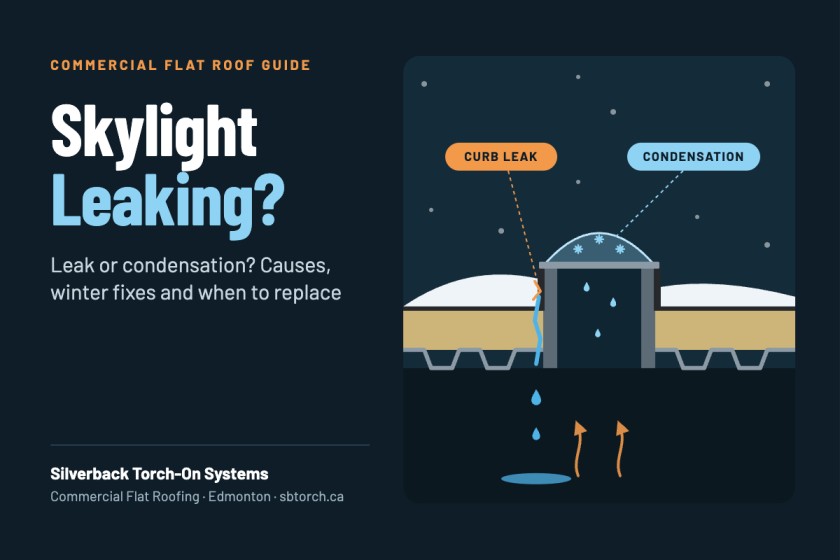
Before calling for repairs, rule out condensation. In Edmonton winters, warm indoor air rises toward skylights, the coldest surfaces in the ceiling, and condenses on them. When there’s enough moisture, it drips like a leak.
| Sign | Condensation | Skylight Leak |
|---|---|---|
| When it happens | Cold snaps, cold mornings | Thaws, rain, snowmelt |
| What you see | Fog, frost or droplets on the inside of the dome or glass | Water running down the curb or frame |
| Where it drips | From the glazing surface | From the edges of the frame or curb |
| Indoor humidity | Often high: kitchens, pools, manufacturing, car washes | Not related to humidity |
If you see fog, frost or beads of water on the inside of the skylight during cold weather, condensation is the likely cause. For a complete diagnosis guide, read roof leak or condensation in commercial buildings.
7 Common Causes of Commercial Skylight Leaks
1. Failed Curb Flashing
The membrane flashing that runs up the curb is the most common leak point. Over time, flashing can crack, pull away or lose adhesion, especially where it meets the skylight frame. Freeze-thaw cycles widen small gaps every season.
2. Curbs That Are Too Low
Many older skylight curbs were built for thinner roofs. When roofs are re-covered or insulation is added, the curb can end up only a few centimetres above the finished roof. Snow and meltwater then reach the frame easily. In Edmonton, a low curb is a winter leak waiting to happen.
3. Snow Drifts Around Skylights
Skylights sit above the roof surface, so snow drifts around them. Drifted snow melts during sunny days and refreezes at night, holding water against the curb flashing for weeks. Ice can also force water under counter-flashing.
4. Cracked, Crazed or Aged Domes
Acrylic and polycarbonate domes become brittle with age and UV exposure. Fine cracks (“crazing”) and larger cracks let water through. Hail can also crack or puncture domes.
5. Failed Seals and Gaskets
The seals between the skylight frame and glazing shrink and harden in Edmonton’s cold. Once they fail, water and air pass straight through.
6. Blocked Weep Holes
Weep holes let condensation that collects inside the frame drain outside. When they’re blocked by dirt, debris or ice, the water has nowhere to go but inside.
7. Old Caulk Patches
Many skylights have been “repaired” with layers of caulk. Caulk breaks down quickly in cold weather and UV exposure, and it often traps water instead of stopping it. Heavy caulking is usually a sign the real problem was never fixed.
Why Edmonton Winters Make Skylight Leaks Worse
- Freeze-thaw cycles open small cracks in flashing and seals
- Snow drifts hold meltwater against curbs
- Ice forms in weep holes and at the base of curbs
- Cold glazing increases condensation inside
- Sun on the dome melts nearby snow during the day, even when the air is below zero
That’s why many skylight leaks appear during the first thaws of spring or during winter warm spells.
Skylights Are Also a Fall Hazard
Skylights are a serious safety risk on commercial roofs. Many skylight domes can’t support a person’s weight. When snow covers the roof, skylights can be hard to see.
Anyone working near skylights should be protected. Skylight screens, guardrails or other fall protection reduce the risk. If you’re re-roofing, it’s a good time to add permanent skylight protection. Learn more about commercial roofing safety in Edmonton.
How Commercial Skylight Leaks Are Fixed
Re-Flashing the Curb
When curb flashing has failed, the old flashing is removed and new membrane flashing is installed up the curb and properly sealed to the frame. With 2-ply SBS systems, this creates a durable, two-layer seal around the opening.
Raising the Curb
If the curb is too low, it can be raised during re-roofing so the skylight sits well above the roof surface, snow line and new insulation. This is one of the most effective long-term fixes.
Replacing Seals or Glazing
Cracked domes and failed seals can sometimes be replaced without replacing the whole skylight. If the unit is old, damaged or inefficient, replacement is often better value.
Clearing Weep Holes and Debris
Simple maintenance, like clearing weep holes and removing debris around the curb, can stop some leaks entirely.
Reducing Condensation
If condensation is the problem, solutions focus inside the building: lowering humidity, improving ventilation and air sealing around the skylight well. Insulated or higher-performance skylights also reduce condensation.
Temporary Winter Repairs
In winter, a roofer can make temporary repairs to stop active leaks and plan permanent fixes for warmer weather. Never send staff onto a snowy roof near skylights.
Repair or Replace the Skylight?
Repair usually makes sense when:
- The skylight unit is in good condition
- The leak comes from flashing, seals or weep holes
- The curb height is adequate
Replacement usually makes sense when:
- The dome is cracked, crazed or yellowed
- The unit is old and inefficient
- Leaks keep returning after repairs
- You’re re-roofing anyway
Re-roofing is the best time to address skylights. Replacing the roof without fixing low curbs or old skylights leaves the weakest points in place. Coordinating skylight replacement, curb raising and fall protection with commercial re-roofing gives you a watertight, safer roof for decades.
Skylight Maintenance Checklist
Inspect skylights every spring and fall:
- Check curb flashing for cracks, gaps and separation
- Look for cracks, crazing or yellowing in domes
- Inspect seals and gaskets
- Clear weep holes and debris
- Check for snow drift patterns and drainage around curbs
- Confirm skylight screens or guards are secure
- Look for interior stains around skylight wells
Add skylights to your regular commercial roof inspection so small problems are caught early.
Frequently Asked Questions
Why does my skylight only leak in winter?
Winter leaks around skylights are usually caused by snow drifts holding meltwater against the curb, ice forcing water under flashing, or condensation on cold glazing. Each needs a different fix, so confirm the cause first.
How do I know if my skylight leak is condensation?
If you see fog, frost or water droplets on the inside of the skylight during cold weather, especially in humid buildings, condensation is the likely cause. Leaks usually appear during thaws or rain and run from the edges of the frame or curb.
Can a commercial skylight leak be fixed in winter?
Temporary repairs can be made in winter to stop water entering the building. Permanent flashing repairs and replacements are best completed in warmer weather.
Should I replace skylights when I replace my roof?
Often, yes. Re-roofing is the ideal time to replace aging skylights, raise low curbs and add fall protection, so every opening in the new roof is properly sealed.
Are commercial skylights safe to walk near?
Many skylight domes can’t support a person’s weight, and snow can hide them. Anyone working near skylights should use proper fall protection, and skylight screens or guardrails are recommended.
How can I prevent skylight leaks?
Inspect skylights each spring and fall, keep weep holes clear, manage snow drifts around curbs, avoid caulk-only repairs, and fix flashing problems early.
Stop Skylight Leaks at the Source
A dripping skylight is more than a nuisance. It can damage inventory, ceilings and insulation, and it’s often a sign of a bigger flashing or curb problem. The right fix starts with the right diagnosis.
Silverback Torch On Systems helps Edmonton property owners diagnose and repair skylight leaks on commercial flat roofs, from curb re-flashing to skylight replacement during re-roofing.
Book a commercial roof inspection or call our Edmonton team at 587-785-6924. Learn more about our commercial roof repair and maintenance services.