


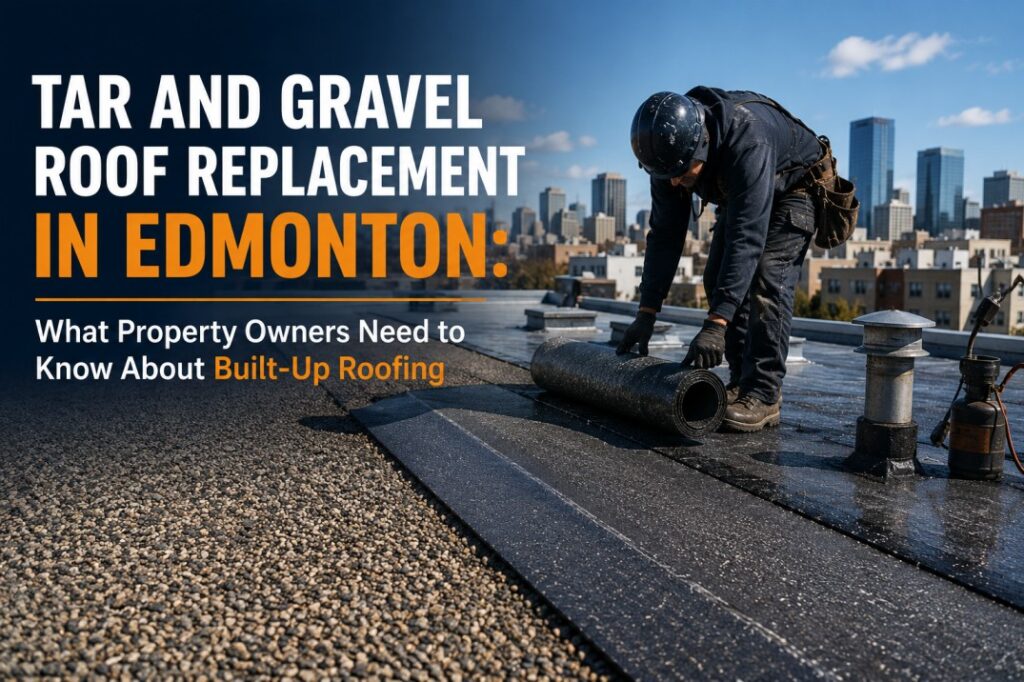
Walk through any established Edmonton commercial area — 118th Avenue, 82nd Street, the older industrial sections of the northeast, or the commercial strips that grew up through the 1970s, 80s, and 90s — and the roofline tells a consistent story. Thousands of Edmonton commercial buildings still carry their original tar and gravel roofing systems, or systems that were re-roofed with tar and gravel in decades past.
These roofs are reaching — or have already passed — the end of their functional service lives. Some of them are leaking. Some are ponding water that’s deteriorating the gravel surface and stressing the underlying bitumen layers. Some have been patched multiple times, accumulating a history of temporary fixes that were never quite enough. And many have property owners who aren’t sure whether another repair is worth the money, or whether it’s time to stop patching and replace.
This guide explains what tar and gravel built-up roofing actually is, how to assess whether an existing BUR system is worth maintaining or needs replacement, what the replacement options are, and what Edmonton property owners should expect in terms of process and cost when they take on a BUR replacement project.
What Is Tar and Gravel / Built-Up Roofing?
Tar and gravel roofing — correctly called built-up roofing or BUR — is one of the oldest and most historically widespread flat roofing systems in North America. It was the dominant commercial flat roofing system installed in Edmonton from roughly the 1950s through the late 1990s, when modified bitumen (SBS) systems began taking a larger market share.
A built-up roofing system is constructed from multiple alternating layers of bitumen and reinforcing fabric felts, built up on the roof surface to create a waterproof membrane. The standard specification in Edmonton’s era of heavy BUR use was a “3-ply” or “4-ply” system — three or four alternating layers of bitumen and felt — topped with a flood coat of hot bitumen into which gravel aggregate is embedded. The gravel serves three functions: it protects the underlying bitumen layers from UV degradation, provides ballast that holds the membrane in place against wind uplift, and gives the roof its characteristic appearance.
BUR systems were genuinely durable for their era. A properly installed 4-ply BUR system on an Edmonton commercial building in the 1970s was designed for a 20 to 30 year service life. Many of those roofs reached that design life and were replaced or re-roofed on schedule. Many others were not — and some of those original BUR systems, or their first re-roofing overlays, are still in service decades past their design life expectancy.
What has changed is not the fundamental engineering of these systems — BUR is still a legitimate roofing approach — but the comparison context. Modern SBS modified bitumen, TPO, and EPDM systems offer performance characteristics, installation speed, and warranty structures that make new BUR installation relatively uncommon in 2026. When an Edmonton commercial building’s BUR system reaches the end of its life today, the replacement conversation is almost always about transitioning to a modern membrane system rather than installing new BUR.
Why Edmonton’s Climate Accelerates BUR Deterioration
Tar and gravel built-up roofing faces specific deterioration mechanisms in Edmonton’s climate that accelerate the aging process compared to milder markets:
Bitumen oxidation from UV exposure. The flood coat bitumen beneath the gravel surface oxidizes when UV radiation penetrates through gaps in the gravel layer — gaps that develop as gravel aggregate migrates to low spots and drain areas over time. Oxidized bitumen loses its plasticizers and becomes brittle, cracking under thermal movement rather than flexing with it. In Edmonton, where summers deliver significant UV intensity across long daylight hours, bitumen oxidation on aggregate-depleted zones progresses faster than in cloudier or lower-latitude markets.
Thermal movement cracking. Edmonton’s annual temperature swing of 65°C or more drives thermal expansion and contraction in the BUR assembly through every seasonal and daily cycle. In a multi-ply BUR system, the bitumen and felt layers bond together — but they also bond to the roof deck below, which means thermal movement produces stress across the entire bonded assembly rather than distributing it through a more flexible single-ply or two-ply membrane. Over decades of Edmonton winters and summers, this accumulated thermal stress produces cracking and splitting in the bitumen layers that eventually reaches full thickness.
Gravel migration and surface exposure. Edmonton’s 200-plus annual freeze-thaw cycles, combined with wind events and the occasional chinook-driven thermal shock, cause gravel aggregate to migrate across BUR roof surfaces over time. Aggregate collects in low spots, around drains, and at parapet wall bases — leaving elevated areas of the membrane surface with depleted gravel cover. Once the gravel layer thins sufficiently, UV radiation reaches the flood coat bitumen directly, dramatically accelerating oxidation in those exposed zones. A BUR system with significant gravel migration typically shows a distinctive pattern of surface deterioration — cracking and alligatoring in exposed high areas, with accumulated gravel at drains and edges.
Felt layer delamination. In the multi-ply BUR assembly, each felt layer is bonded to adjacent layers through the bitumen flood. When water infiltrates the assembly — through a surface crack, around a failed flashing detail, or through a deteriorated drain collar — it can travel laterally through the BUR system between felt layers, causing delamination of the bonded assembly over an area significantly larger than the original entry point. Delaminated BUR sections appear as blistering or bubbling on the surface and represent areas where the waterproofing function of the multi-ply system has already been compromised.
Drain sedimentation. The gravel aggregate on BUR roofs produces fine mineral sediment over time through weathering and traffic. This sediment migrates into internal drain assemblies with every precipitation event, progressively restricting drain flow capacity even when the drains appear unobstructed from the surface. Edmonton BUR buildings with drains that haven’t been professionally cleaned in years often have significantly reduced drainage capacity — contributing to ponding that accelerates the deterioration cycle described above.
How to Assess Whether Your BUR Roof Needs Repair or Replacement
The honest answer to “should I repair or replace my Edmonton BUR roof?” is that it depends on conditions that can only be reliably assessed through professional inspection — not a visual check from the roof surface.
That said, there are observable indicators that point strongly toward replacement rather than continued repair:
Surface alligatoring over more than 15 to 20 percent of roof area. Alligatoring — the distinctive cracking pattern that resembles alligator skin — indicates that the top bitumen layers have lost their elasticity through oxidation and can no longer flex with thermal movement. When alligatoring covers a significant proportion of a BUR roof surface, the remaining useful life of the overall membrane system is limited regardless of localized repair work. Repairing alligatored areas extends life only in those specific zones — the surrounding membrane continues deteriorating at its current rate.
Blistering or delamination visible in multiple locations. Multiple blistered zones on a BUR surface indicate that moisture infiltration into the membrane assembly has occurred at multiple points. Each blister represents a location where water has entered the felt layer structure and caused delamination. When blistering is scattered across the roof rather than concentrated near a single identifiable entry point, it indicates a membrane system that has been admitting water broadly — and the extent of moisture infiltration beneath the visible blisters is likely much larger than the blisters themselves suggest. Infrared moisture scanning can map the full extent.
Core samples showing saturation through multiple plies. A professional assessment that includes extracting and examining core samples from the BUR assembly can confirm whether moisture has penetrated through one or multiple felt layers. A single-ply moisture infiltration in an otherwise sound BUR system may be remediable. Moisture confirmed through all three or four plies indicates a membrane that has lost its waterproofing function throughout — replacement is the appropriate response.
Multiple failed repairs at the same locations. When the same area of an Edmonton BUR roof has been patched two or three times and continues to admit water, the problem is not the specific repairs — it’s that the underlying membrane has deteriorated to the point where repairs cannot hold. Continued patching on a fundamentally compromised BUR system is spending money to defer an inevitable replacement without extending the building’s actual weather protection.
Confirmed wet insulation through infrared scanning. A professional commercial roof inspection that includes infrared moisture scanning can confirm whether water has infiltrated through the BUR membrane into the insulation layer below. Wet insulation beneath a BUR system means the membrane has been allowing water ingress long enough to saturate the insulation — and that insulation typically needs replacement regardless of what happens to the membrane above it.
When any of these conditions are present, a repair-focused approach is unlikely to deliver cost-effective results over the medium term. The repair cost accumulates while the underlying problem continues progressing, and the eventual replacement happens on a building that has sustained more damage than if replacement had been undertaken when the signals first appeared.
Replacement Options: What Goes on an Edmonton BUR Roof When It Comes Off
When an Edmonton commercial building’s tar and gravel BUR system is replaced, the property owner has three primary modern membrane options — and the choice is made based on the same factors that govern any Edmonton commercial flat roof system selection:
Option 1: SBS Modified Bitumen Torch-On (Two-Ply)
SBS modified bitumen is the most common system specified for BUR replacement in Edmonton, and the transition from BUR to SBS is well-established in Alberta’s commercial roofing market. After BUR tear-off and deck preparation, a two-ply SBS system installs directly over new or existing sound insulation — base sheet heat-welded to the insulation board, cap sheet torch-applied over the base sheet with all seams fully fused.
SBS offers several advantages specific to BUR replacement projects: its rubber-modified composition is better suited to Edmonton’s freeze-thaw cycle than standard bitumen, its two-ply construction maintains redundant waterproofing that BUR property owners are accustomed to, and the heat-welded seam system creates a reliable waterproof bond without the adhesive vulnerabilities that EPDM carries in Edmonton’s cold environment.
The cost range for SBS replacement of a BUR system in Edmonton — including full BUR tear-off, deck inspection and repair where needed, insulation upgrade to current Alberta Building Code minimum (RSI 3.52 / R-20), and new two-ply SBS installation — runs approximately $12 to $18 per square foot in 2026 market conditions depending on building complexity, access, and the extent of deck repair required. Read more about what drives these cost variations in our commercial flat roof repair and replacement cost guide for Edmonton.
Option 2: TPO Single-Ply (60-mil Minimum)
TPO offers a meaningful energy performance advantage for Edmonton BUR replacement projects on buildings with significant cooling loads. The white reflective surface reduces summer solar gain relative to the dark BUR surface it replaces — a difference that property managers in older Edmonton commercial buildings with minimal original insulation often notice in reduced HVAC operating costs in the first full summer after replacement.
The specification requirement for Edmonton BUR replacement — 60-mil minimum TPO membrane, with 80-mil preferred — ensures adequate membrane thickness for the freeze-thaw stress environment. BUR replacement is a full tear-off project in most cases, which means insulation upgrade to current code minimums happens naturally as part of the project scope.
Option 3: EPDM Single-Ply
EPDM is less commonly specified for BUR replacement in Edmonton’s market than SBS or TPO, primarily because the adhesive seam system performs less reliably through Edmonton’s 200-plus annual freeze-thaw cycles than heat-welded alternatives. For very large-footprint BUR replacement projects where minimizing seam count is a priority, EPDM’s wide sheet widths offer a practical advantage — but this benefit must be weighed against the long-term maintenance requirements at penetration seam areas.
Can a BUR Roof Be Re-Roofed Rather Than Replaced?
The question of whether an Edmonton BUR roof qualifies for re-roofing overlay — installing a new SBS membrane over the existing BUR system without tear-off — rather than full replacement is one of the most important early decisions in any BUR end-of-life project. The answer determines not just cost but also what happens to any moisture already present in the system.
BUR re-roofing overlay is technically possible and code-compliant when:
- The existing BUR membrane is structurally intact with no widespread delamination or blistering
- Professional moisture testing confirms dry insulation beneath the BUR assembly
- The building has not previously been re-roofed over the BUR (Alberta code limits most commercial buildings to two total membrane layers)
- The existing BUR surface is sound enough to serve as a compatible substrate for the new SBS base sheet
- Drainage remains adequate with the added membrane thickness
The critical condition is the moisture testing. BUR systems that have developed internal delamination admit water laterally through the felt layer structure — and infrared scanning of the full BUR surface area before any re-roofing decision is the only reliable way to confirm whether that moisture is isolated or widespread. A re-roofing overlay over saturated BUR insulation traps that moisture permanently beneath the new membrane, leading to early failure of the new system and typically requiring full replacement sooner than if the correct scope had been chosen at the outset.
Our complete guide to commercial re-roofing vs. full replacement in Edmonton covers the full decision framework applicable to BUR systems as well as modern membranes.
The Tear-Off Process: What to Expect When BUR Comes Off
Property owners unfamiliar with BUR tear-off projects are sometimes surprised by the scope of the process. Here’s what the tear-off phase of an Edmonton BUR replacement actually involves:
Gravel removal. The surface aggregate on a BUR roof typically represents 20 to 40 kilograms per square metre of material that must be removed before the membrane layers below can be accessed. On a 10,000 square foot BUR roof, this is 20,000 to 40,000 kilograms of gravel — a substantial material handling task that requires mechanical equipment (vacuum systems or mechanical rakes with conveyors) for any project of meaningful size. Gravel removal alone represents a meaningful proportion of BUR tear-off labour cost and is one of the primary reasons BUR replacement costs more than standard SBS replacement projects.
Membrane layer removal. After gravel removal, the multiple layers of bitumen and felt are removed to expose the deck surface below. On older Edmonton BUR installations, this material is often adhered directly to the insulation below — which means insulation boards that were bonded to the BUR membrane frequently come up with the membrane, necessitating full insulation replacement regardless of moisture condition.
Deck inspection and repair. BUR tear-off exposes the roof deck surface for the first time since original installation or the last replacement. Deck condition assessment at this stage often reveals deterioration that wasn’t detectable from the surface — rotted or delaminated plywood sections, corroded metal deck, or fastener degradation. Deck repair scope, if required, is typically identified and quoted separately from the membrane replacement scope, and property owners should confirm with their contractor how discovered deck damage will be handled contractually before tear-off begins.
Insulation installation. With the deck exposed, new insulation is installed to current Alberta Building Code minimum specification (RSI 3.52 / R-20) before the new membrane system goes down. For Edmonton BUR buildings constructed under older code standards, this insulation upgrade is often a meaningful improvement over what was previously in place — and it delivers long-term energy performance benefits alongside the improved waterproofing of the new membrane system. Learn more about insulation specification requirements in our commercial roof insulation guide for Edmonton.
What Does Tar and Gravel Roof Replacement Cost in Edmonton in 2026?
The 2026 Edmonton cost range for tar and gravel BUR replacement — full tear-off including gravel removal, deck inspection, insulation upgrade, and new SBS or TPO membrane installation — runs approximately $13 to $20 per square foot for most commercial projects in the Edmonton market.
This range is notably higher than standard SBS re-roofing or simple membrane replacement projects for two reasons: the gravel removal labour adds cost that non-aggregate membrane tear-offs don’t carry, and BUR tear-off frequently exposes deck damage that requires repair before new membrane installation can proceed.
Specific factors that push BUR replacement costs toward the higher end of the range include:
- Higher gravel aggregate density (heavier ballast loads require more removal labour)
- Deck damage discovered during tear-off requiring structural repair
- Complex roof geometry with high penetration counts
- Limited crane or material handling access on the site
- Building occupancy requirements that restrict work hours or phasing
Property owners planning an Edmonton BUR replacement project should budget for the possibility of discovered deck damage by asking their contractor how deck repair scope will be quoted and approved — a fixed-price contract without a deck repair allowance mechanism creates incentive for the contractor to underestimate or overlook deck conditions that appear during tear-off.
Getting Your Edmonton BUR Replacement Assessment
Silverback Torch On Systems Ltd. has replaced tar and gravel built-up roofing systems across Edmonton and Northern Alberta as part of the over one million square feet of commercial flat roofing we’ve installed in the region. Our BUR replacement assessments include infrared moisture scanning to confirm insulation condition, gravel aggregate density evaluation, deck accessibility assessment, and a detailed written proposal with full material specifications and a clear framework for how any discovered deck damage will be handled.
If your Edmonton commercial building carries an aging tar and gravel roof that you believe is approaching the end of its service life — or that has already begun requiring frequent repairs — contact our Edmonton team for a free on-site assessment.
For additional information on related topics, see:
- Commercial Flat Roofing in Edmonton: Service Page
- Commercial Re-Roofing Service
- Commercial Roof Repair and Maintenance
Quick Reference: Tar and Gravel BUR Replacement Guide
| Question | Answer |
|---|---|
| What is tar and gravel / BUR roofing? | Multi-ply bitumen and felt system topped with flood coat bitumen and gravel aggregate |
| Typical original service life in Edmonton | 20–30 years from installation |
| Signs replacement is needed | Alligatoring >15%, multiple blistered zones, repeated failed repairs, wet insulation confirmed |
| Can it be re-roofed without tear-off? | Yes, when insulation is dry, deck is sound, and layer count allows — moisture testing required |
| Replacement system options | SBS two-ply torch-on (most common), TPO 60-mil minimum, EPDM |
| 2026 Edmonton replacement cost range | $13–$20 per square foot (full tear-off including gravel removal, insulation, new membrane) |
| Why more expensive than other tear-offs? | Gravel removal labour + frequent deck repair discovery during BUR tear-off |
| Who to hire? | COR-certified commercial flat roofing specialist with documented Alberta BUR experience |
Related reading for Edmonton commercial property owners:
- Commercial Re-Roofing vs. Full Replacement: How Edmonton Property Owners Should Decide
- Commercial Flat Roof Repair and Replacement Cost in Edmonton: A 2026 Guide
- SBS vs TPO vs EPDM: Which Flat Roof System Is Right for Your Edmonton Commercial Building?
- Commercial Roof Insulation in Edmonton: What Every Property Owner Needs to Know