


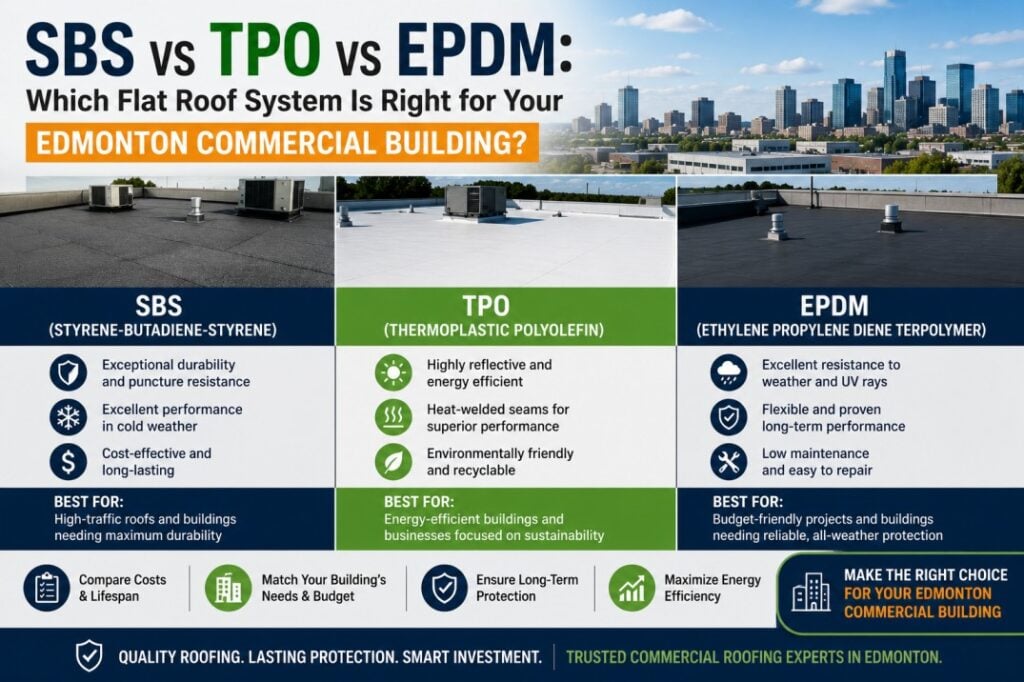
When a commercial flat roof reaches the end of its service life in Edmonton, property owners face a real decision — not just about which contractor to hire, but about which roofing system to put on the building. Three systems dominate commercial flat roofing across Alberta: SBS modified bitumen (torch-on), TPO (thermoplastic polyolefin), and EPDM (ethylene propylene diene monomer).
All three are legitimate systems with proven track records. All three are available from qualified contractors in Edmonton. And all three perform very differently when Edmonton’s climate — with its -35°C winters, +30°C summers, 200+ freeze-thaw cycles annually, and hailstorms — is factored into the long-term picture.
This guide compares all three systems honestly and specifically for Edmonton commercial buildings, so you can make an informed decision before you spend $30,000 to $200,000 or more on a new roof.
Understanding the Three Systems
Before comparing performance, it helps to understand what each system actually is.
SBS Modified Bitumen (Torch-On) SBS stands for Styrene-Butadiene-Styrene — a synthetic rubber compound blended into bitumen (asphalt) to create a flexible, rubber-modified membrane. In Edmonton’s commercial market, SBS is almost always installed as a two-ply torch-on system: a base sheet heat-welded to the insulation board, followed by a granulated cap sheet torch-applied on top. The seams are heat-fused, creating a continuous waterproof bond. SBS is the system Silverback Torch On Systems is built around and the most widely used commercial flat roofing system in Alberta.
TPO (Thermoplastic Polyolefin) TPO is a single-ply membrane manufactured from a blend of polypropylene and ethylene-propylene rubber, reinforced with a polyester scrim. It comes in rolls — typically white, grey, or tan — and is installed across the roof surface with seams heat-welded using a hot-air welding gun. TPO’s white reflective surface is its signature feature, reducing rooftop temperatures in summer and earning Energy Star cool-roof designation. It has held approximately 40% of the North American commercial roofing market since the 2010s.
EPDM (Ethylene Propylene Diene Monomer) EPDM is a synthetic rubber membrane — the oldest of the three systems, commercially available since the 1960s. It comes in large sheets, typically black, installed across the roof with seams joined using adhesive or seam tape rather than heat welding. EPDM’s rubber composition gives it excellent flexibility and a proven 25–30 year track record on commercial buildings across North America. It remains the most common system on large industrial roofs where its large sheet sizes minimize seam count.
Head-to-Head: How Each System Performs in Edmonton
Cold-Temperature Performance
This is the most critical performance factor for Edmonton commercial buildings — and it’s where the three systems diverge most significantly.
SBS: The rubber modifier in SBS membranes maintains flexibility at temperatures as low as -40°C. This is the core reason SBS dominates Alberta’s commercial roofing market. The heat-welded seams move with the membrane through freeze-thaw cycling without pulling apart. For Edmonton’s 200+ freeze-thaw cycles annually, this thermal movement tolerance is a major long-term advantage.
TPO: TPO’s cold-temperature performance depends heavily on the specific formulation and membrane thickness. Entry-level 45-mil TPO membranes can become rigid and crack-prone below -20°C. Premium 60-mil and 80-mil formulations from major manufacturers perform significantly better — but the quality gap between specification grades is wider in TPO than in SBS. In Edmonton’s climate, TPO specification quality matters enormously and under-specified TPO is a genuine risk.
EPDM: EPDM’s rubber composition gives it excellent cold-temperature flexibility — comparable to SBS in raw material terms. However, EPDM’s adhesive and tape seams are its critical vulnerability in Edmonton’s freeze-thaw environment. Seam adhesives can stiffen and lose bond strength at very low temperatures during installation. Existing adhesive seams experience cumulative stress from 200+ annual freeze-thaw cycles. The most common EPDM failure mode in Edmonton’s climate is tape seam separation at corners and penetrations — typically emerging between years 15 and 25.
Winner in Edmonton’s climate: SBS, with premium-spec TPO as a viable alternative and EPDM as the most seam-vulnerable of the three.
Seam Reliability
Seam failure is the leading cause of flat roof leaks on commercial buildings. How each system handles seams is fundamental to long-term waterproofing performance.
SBS: Heat-welded torch-on seams fuse the membrane layers together permanently. When properly executed, the seam is as strong as the membrane itself — there’s no adhesive to fail, no tape to peel, and no gap for water to enter through thermal movement. Seam quality depends on installer skill with torch temperature and overlap technique, which is why specialized contractors matter.
TPO: Hot-air welded seams are TPO’s greatest structural advantage. A properly welded TPO seam creates a chemical bond stronger than the membrane body. The key qualifier is “properly welded” — weld quality depends entirely on the operator’s equipment, technique, and ambient conditions. Cold, windy Edmonton installation days increase the risk of incomplete welds that look solid but leak under load.
EPDM: Adhesive and tape seams are EPDM’s primary vulnerability. They perform well when installed under ideal conditions with proper surface preparation — but they’re sensitive to temperature during installation, contamination, and long-term thermal cycling. On Edmonton’s flat commercial roofs, this seam type carries more long-term risk than heat-welded alternatives.
Winner: SBS and TPO (heat-welded), with EPDM trailing on seam reliability in Edmonton conditions.
Energy Performance
Energy performance has become an increasingly important factor for Edmonton commercial buildings as energy costs rise and Alberta’s code requirements tighten.
SBS: Standard SBS cap sheets with mineral granules absorb solar radiation — not a cool-roof product. Reflective cap sheet options exist (white mineral or factory-applied coatings), but standard SBS is not optimized for summer heat reduction. In Edmonton’s climate, where heating season dominates and summer cooling is secondary, this is a less significant disadvantage than it would be in a warmer city.
TPO: White TPO reflects 70–80% of incoming solar radiation, reducing rooftop surface temperatures by 20–35°C on hot summer days compared to dark membranes. For Edmonton commercial buildings with significant cooling loads — large retail spaces, server rooms, food storage — TPO’s reflectivity offers meaningful summer energy savings. In Edmonton’s longer heating season, the summer savings advantage over SBS is real but less dramatic than in southern climates.
EPDM: Standard black EPDM absorbs solar radiation like SBS — it’s not a cool-roof product. White EPDM is available at a premium cost and improves reflectivity, but still doesn’t match TPO’s performance. Black EPDM does have one thermal benefit specific to Edmonton: in winter, the dark surface absorbs available solar radiation and contributes modestly to snowmelt, which can reduce snow load and drain-blocking ice accumulation.
Winner for summer energy efficiency: TPO. Winner for Edmonton’s overall climate balance: depends on the specific building’s heating vs. cooling load profile.
Durability and Service Life
SBS: A properly installed two-ply SBS system with adequate insulation and drainage lasts 20–30 years in Edmonton’s climate. The two-ply redundancy — base sheet plus cap sheet — means the building has a secondary waterproof layer if the cap sheet is damaged by hail or puncture. This redundancy is particularly valuable given Edmonton’s hailstorm seasons.
TPO: Premium 60-mil and 80-mil TPO systems are warranted for 20–30 years. However, Edmonton’s early experience with TPO includes some pre-2010 formulation failures that gave thinner membranes a difficult reputation in Alberta. Current-generation 60-mil+ TPO from major manufacturers has largely resolved those issues, but the performance gap between membrane thicknesses is significant. 45-mil TPO on an Edmonton commercial roof is an undersized specification.
EPDM: EPDM has the longest proven track record of the three systems, with many installations reaching 25–30+ years before requiring replacement. The rubber composition ages predictably — EPDM rarely fails catastrophically, it degrades gradually. For large industrial roofs where simplicity and predictability matter most, EPDM’s longevity record is compelling.
Winner on proven track record: EPDM. Winner on redundancy and hail resistance: SBS.
Repairability
SBS: Repairs are straightforward — a torch, membrane material, and a skilled installer. Patches heat-weld directly into the existing membrane with the same technique used for original installation. Any competent commercial flat roofer in Edmonton can execute SBS repairs. This repairability is one reason SBS remains so popular: owners can budget for ongoing commercial roof repair and maintenance with confidence that repairs won’t require specialized equipment or extended project timelines.
TPO: Repairs require a hot-air welding gun and TPO material. Any contractor with TPO installation capability can do this, but it’s more equipment-dependent than SBS patching. Seam repairs require the same welding precision as the original installation — a sloppy repair weld is worse than no repair at all.
EPDM: Patch repairs use adhesive or seam tape — no specialized heat equipment needed, making emergency repairs fast and accessible. The limitation is that adhesive patches are subject to the same long-term seam vulnerability as the original installation. Repeated adhesive repairs in the same area accumulate risk over time.
Winner on repairability: SBS, followed by EPDM for emergency accessibility and TPO for quality-when-done-right.
Which System Is Right for Your Edmonton Building?
No single system is right for every building. Here’s how to think about the decision:
Choose SBS torch-on if: Your building is a warehouse, retail plaza, light industrial facility, or multi-residential property. You want proven two-ply redundancy and straightforward long-term maintenance. Your existing roof is SBS or built-up roofing (compatibility makes re-roofing simpler). You’re working with a specialist contractor whose core expertise is torch-on application.
Choose TPO if: Your building has significant cooling loads and summer energy costs are a material concern. You’re doing new construction where membrane thickness can be properly specified from the start (60-mil minimum for Edmonton). Your contractor has proven TPO installation experience in Alberta’s climate — installation quality matters more with TPO than with any other system.
Choose EPDM if: Your building is a large-footprint industrial facility where minimizing seam count through EPDM’s wide sheet widths is a structural priority. You’re working with a contractor whose primary expertise is EPDM and who has documented long-term performance on Alberta projects. Budget constraints make EPDM’s lower upfront cost relevant to the decision.
The Installation Quality Factor
Across all three systems, the most consistent finding from CRCA research is that 68% of flat roof failures result from installation errors — not material defects. The membrane system matters, but the crew installing it matters just as much.
This is why Edmonton commercial property owners should ask any contractor — regardless of which system they recommend — about their specific certifications, years of local installation experience, and documented project history in Alberta’s climate. A commercial roof inspection of comparable local projects they’ve completed is more informative than any product data sheet.
At Silverback Torch On Systems Ltd., our core specialization is commercial flat roofing in Edmonton using torch-on SBS systems — the membrane we’ve installed, maintained, and repaired across Alberta. If you’re weighing your system options for an upcoming project, contact our Edmonton team for an honest, no-pressure assessment of which approach makes sense for your specific building.
Related reading for Edmonton commercial property owners: