


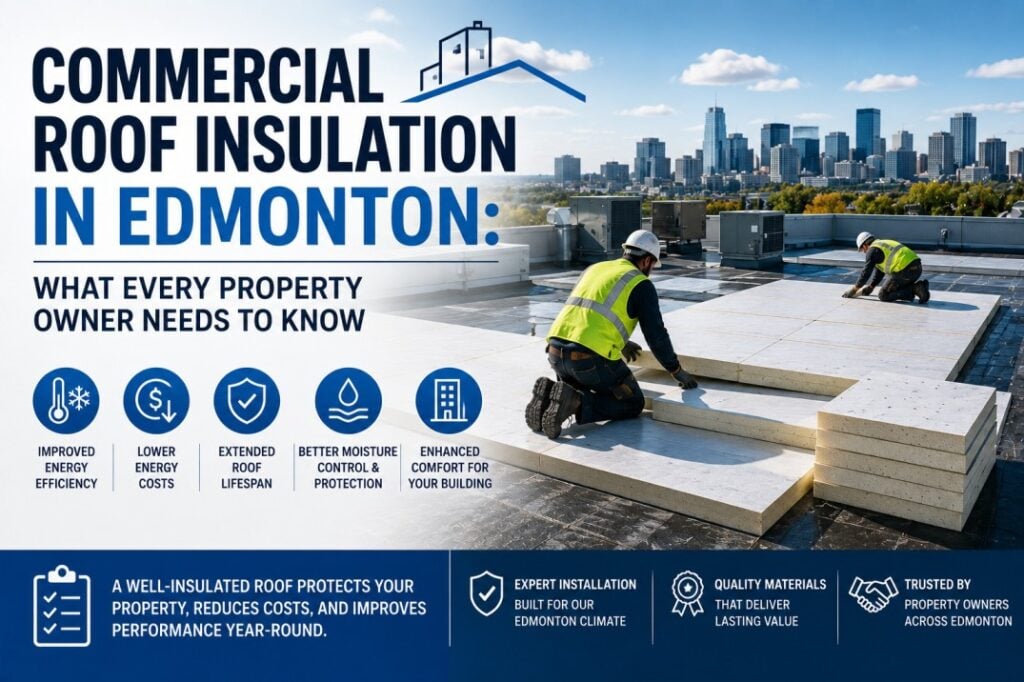
Most Edmonton commercial property owners think about their roof when it leaks. Fewer think about what’s happening inside it — specifically, the insulation layer sitting between the roof deck and the membrane above.
That insulation layer does two jobs simultaneously: it keeps your heating and cooling bills under control, and it protects the structural integrity of your roof system from the inside out. When it’s doing its job well, you don’t notice it. When it’s failing — through age, moisture infiltration, or under-specification — you start noticing it in your energy bills long before you see it on your roof.
Here’s what Edmonton commercial property owners need to know about roof insulation, why it matters more in Alberta’s climate than almost anywhere else in Canada, and what the actual code requirements are for your building.
Why Roof Insulation Is More Critical in Edmonton Than Most Cities
Edmonton sits in Climate Zone 7A under the National Building Code — one of the most demanding thermal performance zones in the country. That designation exists because Edmonton’s climate is genuinely extreme: winters regularly hit -30°C to -35°C, summers push past +30°C, and the annual swing between those extremes exceeds 60°C.
Every degree of that temperature difference puts pressure on your roofing system. Heat generated inside your building in winter tries to escape upward through the roof. Solar heat absorbed by your roof membrane in summer tries to push downward into your conditioned space below. Well-specified insulation slows both of those heat transfer processes — reducing the energy your HVAC system needs to maintain comfortable indoor temperatures year-round.
For Edmonton commercial buildings, this isn’t a minor efficiency consideration. It’s a significant operating cost issue. Properly insulated commercial flat roofs can reduce annual heating and cooling costs by 25–35% compared to under-insulated systems. For a warehouse, retail plaza, or apartment building running year-round HVAC, that difference is real money every month.
What Is R-Value and Why Does It Matter for Your Flat Roof?
R-value measures thermal resistance — how effectively an insulation material slows heat transfer. The higher the R-value, the better the insulation performs. In commercial roofing, R-value is the key specification number that determines both code compliance and real-world energy performance.
The important thing to understand about R-value in Edmonton’s climate is this: the number on an insulation product’s data sheet is not always the number you get in January. Some insulation types — particularly polyisocyanurate (polyiso), the most common commercial roof insulation product — experience what’s called cold temperature R-value loss. Polyiso is rated at approximately R-6 per inch under standard test conditions, but at -20°C its effective R-value can drop to R-4 to R-4.5 per inch. That means a 3-inch polyiso board you spec at R-18 may be delivering closer to R-12 to R-13.5 during Edmonton’s coldest months.
This matters because if that gap pushes your roof assembly below the Alberta Building Code minimum, your building is both out of compliance and losing significantly more heat than you’re paying for on paper.
Alberta Building Code Requirements for Commercial Roof Insulation
The 2019 Alberta Building Code sets a minimum thermal resistance of RSI 3.52 — equivalent to approximately R-20 — for commercial flat roofs. This applies to new construction and major re-roofing projects on commercial buildings.
Key compliance points Edmonton property owners need to understand:
Continuous insulation above the deck. The Alberta code requires insulation to be continuous — meaning it must eliminate thermal bridging through fasteners, metal curbs, and structural connections. Mechanically fastened insulation systems where steel fasteners penetrate through the insulation board can reduce effective R-value by 10–20% through thermal bridging alone. This is one of the reasons fully adhered systems perform better thermally than mechanically fastened ones.
Vapour barrier placement. A continuous vapour barrier must be installed on the warm side of the insulation — between the insulation and the building interior. This prevents warm, humid interior air from reaching the cold insulation layer and condensing. Vapour barrier failures lead to wet insulation, which reduces thermal performance and compromises the entire roof assembly from within.
Existing buildings. Buildings constructed under previous codes are generally not required to retrofit insulation unless they’re undertaking major renovations that affect 50% or more of the roof area. However, if you’re doing a commercial re-roofing project anyway, it’s worth bringing insulation up to current code during that work — because once the new membrane is down, accessing the insulation layer again means tearing it back off.
Exceeding minimum R-20. Upgrading from the code minimum of R-20 to R-30 typically adds cost per square foot in additional materials and labour. For a 10,000 square foot commercial roof, that upgrade pays back through energy savings relatively quickly given Edmonton’s long heating season — typically within five to eight years depending on your building’s heating costs.
The Three Main Insulation Types for Edmonton Commercial Flat Roofs
Polyisocyanurate (Polyiso) The most widely used commercial roof insulation in Canada. Highest R-value per inch under standard conditions (R-5.7 to R-6.5), excellent compressive strength, and compatible with virtually all commercial flat roofing membranes including SBS modified bitumen. The cold-temperature R-value drop described above is the key limitation in Edmonton — which is why hybrid assemblies that combine polyiso with a base layer of EPS or XPS are increasingly specified for Zone 7A buildings.
Extruded Polystyrene (XPS) Dense foam board — typically blue or pink — with a consistent R-value of approximately R-5 per inch that holds stable at cold temperatures. XPS is valued for its moisture resistance and dimensional stability, making it well-suited for Edmonton’s freeze-thaw conditions. Often used as the bottom layer in a hybrid insulation assembly beneath polyiso to maintain code-compliant effective R-value through winter.
Expanded Polystyrene (EPS) Lower density foam with moderate thermal performance (R-3.8 to R-4.2 per inch). Commonly used in tapered insulation systems, where boards are cut at varying thicknesses to create slope toward drains on flat roofs. EPS holds its R-value reasonably well in cold and is the most economical option — but requires more thickness to reach the same R-value as polyiso or XPS.
Tapered Insulation: Solving Two Problems at Once
One of the most cost-effective upgrades available during a commercial roof replacement or re-roofing project in Edmonton is tapered insulation. Instead of flat boards installed at uniform thickness, tapered boards are cut at varying angles to create a manufactured slope across the roof surface — directing water toward drains without requiring structural changes to the building.
For Edmonton commercial buildings with persistent ponding water issues, tapered insulation solves the drainage problem and upgrades thermal performance simultaneously — making it one of the most efficient investments available during a commercial re-roofing project.
How Wet Insulation Destroys Thermal Performance — and Your Roof
When water infiltrates a commercial roof assembly and saturates the insulation layer, the consequences compound quickly. Wet insulation can lose up to 40% of its thermal resistance — so an R-20 assembly performing at code minimum can drop to an effective R-12, driving heating costs up sharply in winter.
Beyond energy performance, wet insulation accelerates the decay of the roof deck beneath it, promotes mold growth within the assembly, and makes the building ineligible for re-roofing (because installing a new membrane over saturated insulation permanently traps that moisture). By the time wet insulation causes visible damage, the repair scope is almost always much larger than if the moisture had been caught earlier through a commercial roof inspection including infrared moisture scanning.
This is why moisture testing is non-negotiable before any re-roofing recommendation — and why addressing small membrane failures through timely commercial roof repair and maintenance protects insulation performance long before it becomes a replacement issue.
What This Means When You’re Planning a Roofing Project
If your Edmonton commercial building is due for re-roofing or full replacement, the insulation decision deserves as much attention as the membrane decision. Specifically, ask your contractor:
1. What is the current insulation R-value and does it meet current Alberta code?
Many older Edmonton buildings were built under previous codes with R-values well below today’s R-20 minimum. A re-roofing project is the practical window to bring them up to current standard.
2. Has the existing insulation been moisture-tested?
Infrared or nuclear moisture scanning before the project starts is the only reliable way to know whether existing insulation can remain in place or needs to be replaced.
3. Is tapered insulation appropriate for this roof?
If drainage is a concern — and on most Edmonton flat commercial roofs it should be — tapered insulation is worth discussing during the project planning phase.
4. What insulation assembly is specified for Edmonton’s climate zone?
Zone 7A conditions make hybrid assemblies (EPS or XPS base layer plus polyiso) worth considering over single-material polyiso specifications that may underperform during Edmonton’s coldest months.
The Bottom Line for Edmonton Property Owners
Your commercial roof’s insulation layer is not a passive component — it’s an active factor in your building’s operating costs, code compliance, and long-term roof system health. In Edmonton’s Climate Zone 7A, getting it right from the start is more important than in virtually any other Canadian city.
Silverback Torch On Systems Ltd. specializes in commercial flat roofing in Edmonton, including the insulation assessment and specification that determines how well your new membrane system performs over its full service life. Whether you’re planning a new installation, a re-roofing project, or simply need an honest assessment of your current system’s condition, contact our Edmonton team for a free on-site roof assessment.
Related reading for Edmonton commercial property owners:
- Ponding Water on Commercial Flat Roofs in Edmonton: Causes, Risks, and Real Solutions
- Commercial Re-Roofing vs. Full Replacement: How Edmonton Property Owners Should Decide
- Torch-On SBS Roofing in Edmonton: What It Is and Why It Works
- Commercial Roofing Materials Guide: Expert Picks for Edmonton’s Climate